
For years, email open rates have been one of the first metrics marketers look at after sending a campaign. A high open rate often feels like proof that a subject line worked, subscribers are engaged, and the campaign was successful. Because of this, open rates became a common benchmark for evaluating email performance across industries.
However, the email landscape has changed dramatically over the past few years. Privacy-focused technologies, automated email filtering systems, and mailbox provider updates have made open-rate tracking less accurate than it once was. In many cases, an email can be recorded as “opened” even when the recipient never actually viewed it.
As a result, marketers in 2026 face an important question: Are email open rates still a meaningful performance metric, or have they become a vanity metric that looks impressive without reflecting real business results?
The answer is more nuanced than a simple yes or no. Open rates still provide useful insights in certain situations, but relying on them as the primary measure of email success can lead to misleading conclusions. Understanding what open rates can and cannot tell you is essential for making smarter marketing decisions.
Why Open Rates Became the “Go-to” Metric

Open rates earned their popularity because they were easy to measure and easy to understand.
Traditionally, email service providers tracked opens using a tiny invisible image known as a tracking pixel. When a recipient opened an email and their email client loaded the image, the action was recorded as an open. This gave marketers a simple way to estimate how many subscribers viewed their messages.
Because of this straightforward tracking method, open rates quickly became one of the most accessible email marketing metrics available. Marketers used them to answer questions such as:
- Did the subject line attract attention?
- Was the sender name recognizable?
- Did the email reach the inbox?
- Is audience engagement increasing or declining?
Over time, open rates became a standard KPI for email campaigns. Teams regularly compared campaign open rates, reported them to stakeholders, and used them to evaluate performance month after month.
Open rates were also useful because they provided immediate feedback. While conversions and revenue could take days to accumulate, open-rate data became available almost instantly after a campaign was sent. This made it easier to test subject lines, send times, and audience segments.
For many years, the metric served as a reasonable indicator of engagement. If more people opened an email, there was a good chance more people were paying attention to the message.
The problem is that the environment in which open rates were originally designed no longer exists.
The Problem with Open Rates Today
The biggest challenge with open rates in 2026 is that they no longer represent actual human behavior as accurately as they once did.
Modern privacy protections have fundamentally changed how email opens are tracked. Many email clients now load tracking pixels automatically, regardless of whether a subscriber reads the email. When this happens, the system records an open even though no real engagement occurred.
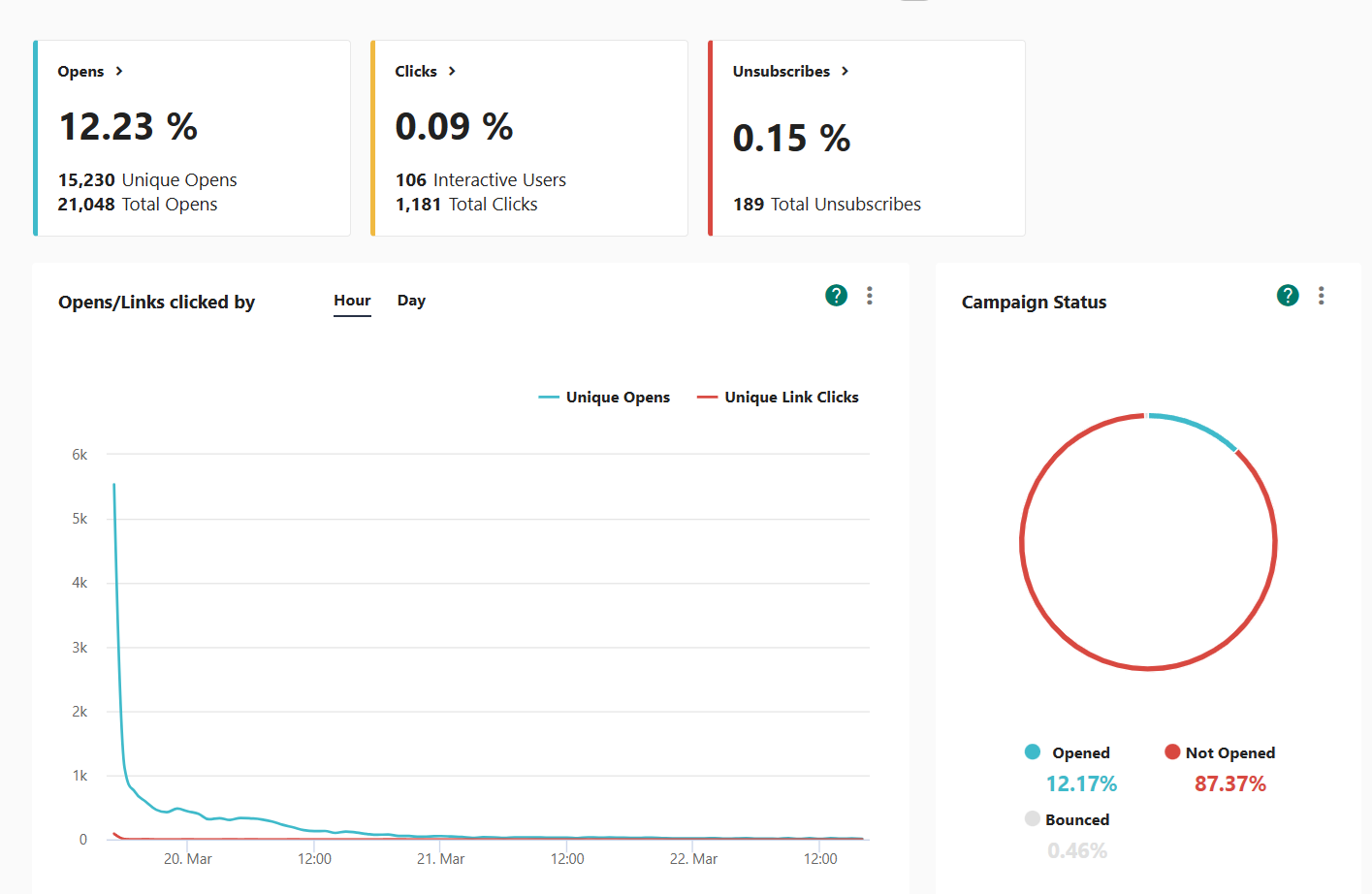
One of the most significant changes came from Apple Mail Privacy Protection (MPP). This feature preloads email content and tracking pixels in the background, making many emails appear opened even when recipients never viewed them. As Apple Mail accounts represent a substantial portion of email users, this has significantly inflated reported open rates across the industry.
In addition to privacy protections, other factors can distort open-rate data:
- Security software may scan emails and trigger tracking pixels automatically.
- Corporate email gateways often inspect messages before delivery.
- Image caching and proxy servers can interfere with tracking accuracy.
- Some users read emails with images disabled, preventing opens from being recorded.
- Automated systems may generate false opens that do not represent genuine engagement.
These limitations create two major problems.
First, open rates can overstate engagement by counting automated activity as human interaction.
Second, open rates can understate engagement when subscribers read emails without triggering tracking pixels.
As a result, marketers can no longer assume that a higher open rate automatically means a more successful campaign.
For example, a campaign may achieve an impressive open rate but generate very few clicks, conversions, or sales. Conversely, another campaign may show a modest open rate while driving significant revenue and customer actions. In such cases, focusing only on opens can create a misleading picture of performance.
This is why many email marketers now view open rates as a directional metric rather than a definitive measure of success. They can still provide useful context, but they should be evaluated alongside metrics that reflect real subscriber actions and business outcomes.
The Metrics that Tell the Full Story
If open rates can no longer be trusted as a standalone measure of engagement, what should marketers focus on instead?
The answer depends on your campaign goals, but the most valuable email metrics are the ones that track actual subscriber actions and business outcomes. These metrics reveal whether your audience is engaging with your content, taking the desired action, and contributing to revenue growth.
Rather than relying on a single number, successful email marketers in 2026 evaluate multiple performance indicators together.
1. Click-Through Rate (CTR)
Click-through rate (CTR) measures the percentage of recipients who clicked on a link within your email.
Unlike opens, clicks require intentional action from subscribers. A click indicates that the recipient found the email content relevant enough to learn more, visit a landing page, browse products, or engage with an offer.
CTR helps answer important questions such as:
- Did the email content resonate with the audience?
- Was the call-to-action compelling?
- Did the offer generate genuine interest?
- Are subscribers engaging beyond simply viewing the message?
For action-oriented campaigns, CTR often provides a much clearer picture of performance than open rates alone.
For example, an email with a 20% open rate and a 6% CTR may outperform an email with a 45% open rate and a 1% CTR because more recipients actually took action.
2. Click-to-Open Rate (CTOR)
Click-to-open rate (CTOR) measures the percentage of people who clicked after opening an email.
While CTR evaluates overall engagement, CTOR focuses specifically on the effectiveness of the email itself.
This metric helps marketers understand:
- Whether the email content matched subscriber expectations.
- If the messaging was persuasive.
- Whether the design supported engagement.
- How effectively the call-to-action encouraged clicks.
A strong subject line may drive opens, but if recipients fail to click, the content may not be delivering on the promise made in the inbox.
Although privacy-related tracking limitations have affected open-rate accuracy, CTOR can still be useful for identifying trends when compared across similar campaigns and audience segments.
When analyzed carefully, CTOR helps reveal how well your email converts attention into engagement.
3. Conversion Rate
Conversion rate measures the percentage of recipients who complete a desired action after interacting with your email.
Depending on your goals, conversions may include:
- Making a purchase
- Booking a demo
- Downloading a resource
- Registering for a webinar
- Starting a free trial
- Completing a lead form
This metric directly connects email marketing activity to business objectives.
An email campaign exists to generate results, not simply opens or clicks. Conversion rate helps determine whether your campaign successfully moved subscribers toward those results.
For many businesses, conversion rate is one of the most important metrics because it reflects meaningful customer behavior rather than passive engagement.
4. Revenue per Email/Campaign
Revenue-focused metrics provide one of the clearest indicators of email marketing success.
Revenue per email and revenue per campaign measure the financial impact generated by your emails.
These metrics help answer questions such as:
- How much revenue did this campaign produce?
- Which audience segments generate the highest return?
- Which email types contribute most to sales?
- Are email marketing investments producing profitable results?
A campaign that generates significant revenue with average open rates is often far more valuable than a campaign with exceptional open rates but little financial impact.
As privacy changes continue to reduce the reliability of open data, many marketing teams are placing greater emphasis on revenue attribution and business outcomes when evaluating campaign performance.
5. Unsubscribe & Spam Complaints
Engagement metrics tell you when things are going well. Unsubscribe and spam complaint metrics tell you when things are going wrong.
These signals help marketers identify potential problems such as:
- Irrelevant content
- Excessive sending frequency
- Poor audience targeting
- Misleading subject lines
- Declining subscriber satisfaction
A campaign may achieve strong opens and clicks while simultaneously increasing unsubscribe rates. If that happens, the apparent success may not be sustainable.
Monitoring unsubscribe and spam complaint trends helps protect sender reputation, maintain deliverability, and preserve long-term audience trust.
When evaluating email performance, positive engagement metrics should always be considered alongside negative engagement signals.
How to Use Open Rates the Right Way

Open rates are not useless. The mistake is treating them as the ultimate measure of success.
In 2026, the most effective approach is to view open rates as a supporting metric that provides context rather than definitive answers.
When combined with other engagement and conversion metrics, open rates can still offer valuable insights.
For Action-Driven Email Campaigns
Action-driven campaigns are designed to encourage a specific response from subscribers.
Examples include:
- Product promotions
- Ecommerce sales campaigns
- Webinar registrations
- Lead generation offers
- Free-trial signups
- Event invitations
For these campaigns, the primary goal is not simply getting opens. The goal is getting results.
Open rates can help evaluate subject-line effectiveness and initial inbox engagement, but they should not be the main KPI.
Instead, prioritize:
- Click-through rate
- Conversion rate
- Revenue generated
- Cost per acquisition
- Return on investment (ROI)
In this context, open rates function as an early signal rather than a final measure of campaign success.
For Zero-Click Newsletters
Not every email is designed to generate clicks.
Many modern newsletters deliver the full value directly within the email itself. Subscribers read the content, consume the information, and move on without needing to visit another page.
These are often called zero-click newsletters.
Examples include:
- Industry news roundups
- Executive briefings
- Creator newsletters
- Thought leadership updates
- Internal company communications
For these types of emails, open rates can still provide useful engagement signals because reading the content is often the intended outcome.
However, marketers should avoid relying on opens alone.
Additional indicators may include:
- Audience retention over time
- Reply rates
- Forwarding activity
- Survey responses
- Subscriber growth
- Reader feedback
In zero-click newsletter environments, open rates remain more relevant than they are for conversion-focused campaigns, but they should still be interpreted with caution due to ongoing privacy-related tracking limitations.
So, Are Open Rates a Trustworthy Metric?

The short answer is: not on their own.
Email open rates are no longer the highly reliable engagement metric they once were. Privacy features, automated image loading, email security systems, and tracking limitations have made it increasingly difficult to determine whether an open represents actual human behavior.
That doesn’t mean open rates are useless. They can still provide directional insights and help marketers identify trends over time. For example, open rates can be useful for comparing subject-line performance, monitoring list health, detecting potential deliverability issues, and evaluating engagement patterns across audience segments.
The problem arises when open rates become the primary measure of success.
An email campaign exists to achieve a business objective, whether that’s generating sales, driving website traffic, collecting leads, increasing product adoption, or strengthening audience relationships. Open rates alone cannot tell you whether those objectives were achieved.
In 2026, the most effective email marketers treat open rates as one piece of a larger performance picture. They combine opens with clicks, conversions, revenue, unsubscribe rates, and other engagement metrics to gain a more accurate understanding of campaign performance.
So, are email open rates a vanity metric?
They can be if they’re the only metric you’re paying attention to.
But when used alongside action-based and outcome-based metrics, open rates still have value as a supporting indicator rather than a standalone KPI.
The smartest approach is not to stop tracking open rates—it’s to stop treating them as the ultimate measure of success.
FAQs
Why are email open rates becoming less reliable?
Email open rates have become less reliable because modern privacy and security technologies interfere with traditional tracking methods. Features such as automatic image loading, privacy protections, email scanning tools, and security gateways can trigger tracking pixels without a subscriber actually reading the email. At the same time, some genuine readers may not be counted if images are blocked or tracking requests are restricted.
As a result, open-rate data no longer provides a completely accurate picture of audience engagement.
Can you still use open rates to improve email performance?
Yes, but they should be used carefully.
Open rates can still help marketers evaluate subject lines, compare audience segments, identify engagement trends, and monitor deliverability changes. However, because open data can be distorted by privacy-related factors, it should be analyzed alongside metrics such as clicks, conversions, and revenue.
Think of open rates as a diagnostic signal rather than a final measure of campaign success.
What is a good alternative to open rates for measuring engagement?
There is no single replacement metric, but click-through rate (CTR), click-to-open rate (CTOR), conversion rate, and revenue-based metrics generally provide a more accurate picture of engagement.
These metrics track actions taken by subscribers rather than passive interactions, making them more closely tied to actual campaign performance.
The best approach is to use a combination of engagement and business metrics instead of relying on one measurement alone.
How can you tell if a campaign truly performed well?
A successful campaign should be evaluated against its intended goal.
For example:
- A sales campaign should be measured by revenue and conversions.
- A lead-generation campaign should be measured by qualified leads.
- A webinar promotion should be measured by registrations and attendance.
- A newsletter should be measured by reader engagement and retention.
When campaign goals are clearly defined, metrics such as clicks, conversions, revenue, unsubscribe rates, and audience growth provide a much more meaningful assessment than open rates alone.
Should you stop reporting open rates altogether?
No. Open rates still provide useful context and can help identify trends in email performance.
However, they should not be the headline metric in your reporting.
Instead of presenting open rates as the primary indicator of success, include them alongside more reliable metrics such as CTR, conversions, revenue, unsubscribe rates, and spam complaints. This creates a more complete and accurate view of how your email campaigns are actually performing.
Read More: Best free email marketing tools