Every email list experiences subscriber disengagement. People change jobs, interests evolve, inboxes become crowded, and priorities shift. As a result, even the healthiest email marketing programs eventually accumulate subscribers who stop opening, clicking, or interacting with campaigns.
To address this, marketers often launch re-engagement campaigns, also known as win-back campaigns. The goal is simple: reconnect with inactive subscribers and encourage them to engage again. On paper, it sounds straightforward. Send an email saying “We miss you,” offer a discount, and wait for people to come back.
In reality, re-engagement campaigns are rarely that successful.
Many businesses invest significant time and resources into win-back emails only to see disappointing results. Open rates remain low, click-through rates barely improve, and inactive subscribers continue to ignore future messages. Some campaigns even damage sender reputation by repeatedly targeting people who have already lost interest.
The problem is not that re-engagement emails no longer work. The problem is that most brands approach them incorrectly.
In 2026, subscriber expectations are higher than ever. People receive countless marketing emails every day, making it harder for generic messages to stand out. At the same time, privacy updates and changing inbox algorithms have made traditional engagement metrics less reliable. Simply sending a last-minute discount or a generic “come back” email is no longer enough.
Successful re-engagement requires understanding why subscribers disengaged in the first place. It means identifying early warning signs, using behavioral data, personalizing outreach, and recognizing that not every inactive contact should be brought back.
Before you can improve your results, you need to understand why most re-engagement campaigns fail. Let’s look at the most common reasons win-back emails miss the mark and what marketers can learn from them.
Why Re-engagement Campaigns Miss the Mark
1. Most Win-Back Emails Arrive Too Late
One of the biggest mistakes marketers make is waiting too long to act.
Many companies define an inactive subscriber as someone who has not opened an email in 90, 120, or even 180 days. By the time a win-back campaign is triggered, the subscriber has often mentally disconnected from the brand.
Think about your own inbox. If you haven’t interacted with a company for six months, how likely are you to suddenly become interested because of a single email? In most cases, the relationship has already weakened beyond repair.
The issue is that disengagement rarely happens overnight. It usually follows a gradual pattern:
- Open rates begin declining.
- Click activity decreases.
- Website visits become less frequent.
- Purchases slow down.
- Email engagement eventually stops altogether.
Most marketers ignore these warning signs until complete inactivity occurs. At that point, the subscriber is already far down the disengagement path.
Modern email marketing platforms provide behavioral signals that can help identify declining engagement much earlier. Instead of waiting until subscribers disappear completely, brands should monitor indicators such as:
- Reduced open frequency
- Lower click activity
- Fewer website visits
- Declining product usage
- Decreased purchase frequency
By detecting disengagement early, marketers can intervene while interest still exists.
For example, a SaaS company might trigger a personalized educational email after noticing that a user has stopped logging into the platform for two weeks. An ecommerce brand could recommend products based on previous purchases when browsing activity starts declining.
Here’s an example from Atlassian:
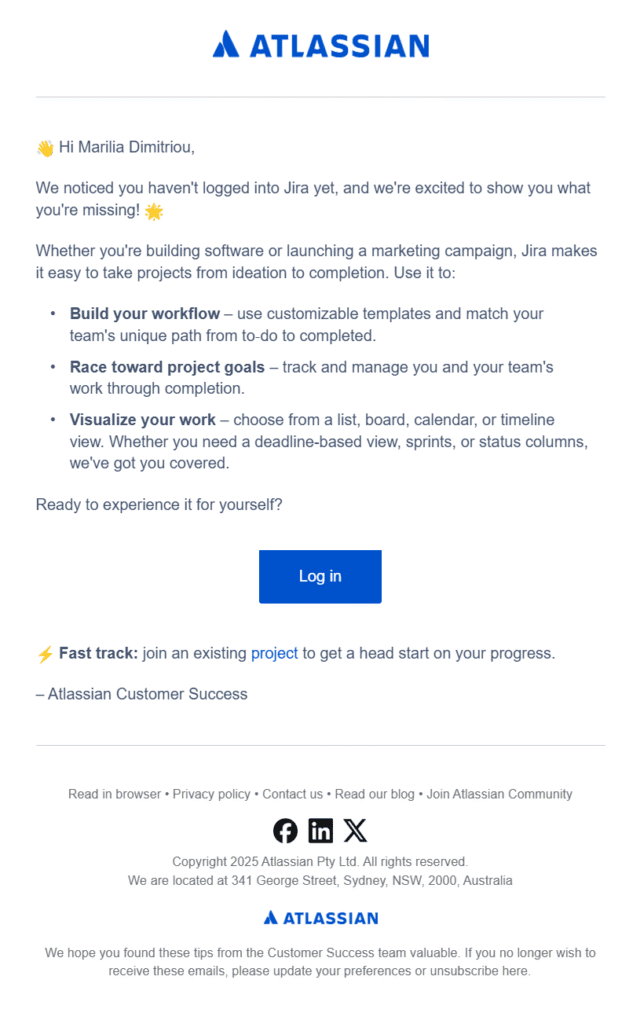
The earlier you respond to disengagement, the greater your chances of restoring engagement before subscribers become permanently inactive.
2. Re-engagement Emails Assume the Wrong Problem
Many win-back campaigns start with a flawed assumption: subscribers stopped engaging because they need a stronger incentive.
This often leads marketers to send discount-heavy emails such as:
- “Here’s 20% off.”
- “Come back and save.”
- “Limited-time offer.”
- “We miss you. Here’s a coupon.”
While discounts can occasionally help, they do not address the real reason many subscribers disengage.
People stop engaging for many different reasons:
- The content is no longer relevant.
- Email frequency feels overwhelming.
- Their needs have changed.
- They already purchased what they needed.
- Competitors offer a better solution.
- The emails fail to provide enough value.
A subscriber who is overwhelmed by daily emails is unlikely to return because of a coupon. Likewise, a subscriber who signed up for educational content may not respond to a sales-focused promotion.
When marketers assume every inactive subscriber has the same problem, they end up sending generic messages that fail to resonate.
A better approach is to identify likely causes of disengagement based on subscriber behavior.
For example:
- Customers who frequently purchased but recently stopped may respond to product recommendations.
- Educational subscribers may respond to valuable content.
- Users with declining platform activity may need onboarding assistance or feature education.
- Subscribers who receive emails too often may benefit from frequency adjustments.
The key is understanding that inactivity is a symptom, not a cause.
Here’s an example from American Giant.
Subject line: We Miss You—Here’s 25% Off
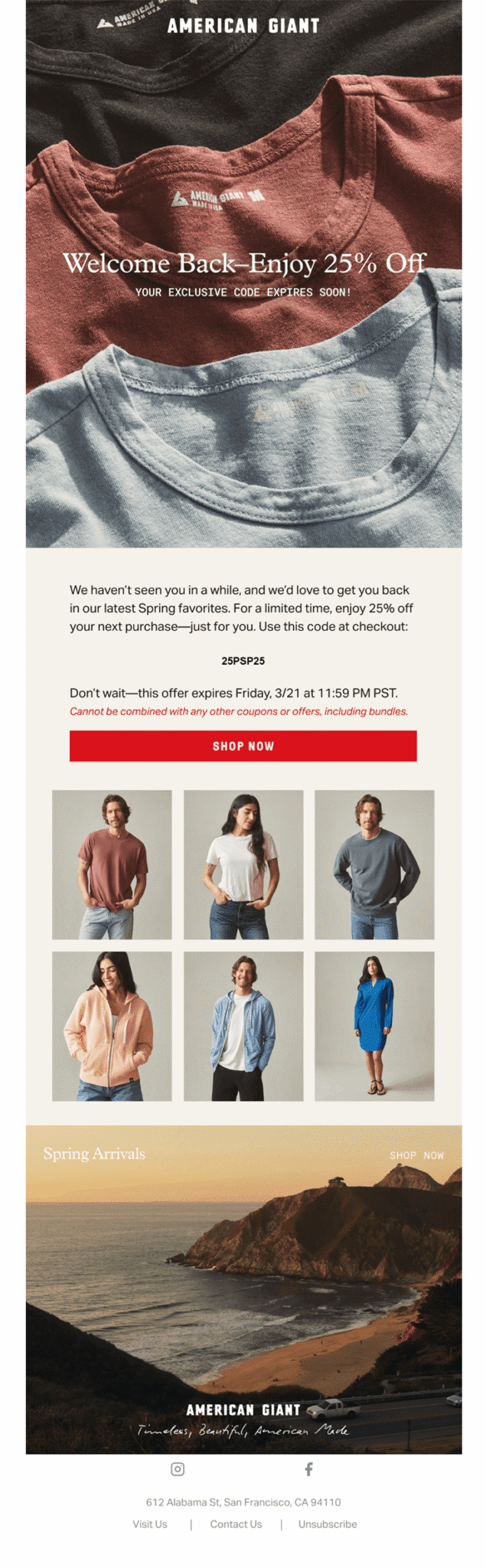
If you want people to re-engage, focus on solving the underlying reason they disengaged rather than immediately reaching for a discount code.
3. Your Win-Back Email Looks Like Everyone Else’s
Inboxes are full of re-engagement emails.
Subscribers regularly see subject lines such as:
- “We miss you.”
- “Come back.”
- “Are we breaking up?”
- “It’s been a while.”
- “Don’t leave us.”
The problem is that nearly every brand uses the same formulas.
As a result, win-back campaigns often blend into the background rather than capturing attention.
Many marketers treat re-engagement emails as a separate campaign rather than an extension of the customer relationship. They focus on getting attention instead of delivering value.
In 2026, personalization matters more than ever.
Subscribers expect brands to recognize their history, preferences, and behavior. Generic win-back messages signal the opposite. They suggest the company knows little about the individual receiving the email.
A stronger re-engagement email might include:
- Personalized product recommendations
- Relevant educational resources
- Content related to previous purchases
- Feature updates based on user interests
- Specific reminders about past activity
For example, instead of saying:
“We haven’t seen you in a while.”
A project management software company could say:
“We noticed you were using task automation features. Here are three new updates that can save your team even more time.”
The second message creates relevance because it acknowledges previous behavior and offers meaningful value.
The most effective re-engagement campaigns feel personal and useful rather than promotional and generic.
4. Your Re-engagement Strategy Often Ignores Context
Not all inactive subscribers are the same.
Yet many marketers place every disengaged contact into a single re-engagement sequence.
This approach ignores one of the most important factors in email marketing: context.
Subscriber behavior is shaped by circumstances that vary from person to person.
Consider these examples:
- A customer purchased a seasonal product and no longer needs frequent updates.
- A business user changed jobs and stopped using the software.
- A subscriber signed up for a webinar but never intended to become a long-term reader.
- A customer already achieved their goal and no longer requires the service.
Each scenario requires a different response.
Without context, marketers risk sending irrelevant messages that further reduce engagement.
Effective re-engagement strategies segment inactive subscribers based on factors such as:
- Purchase history
- Lifecycle stage
- Product usage
- Subscription source
- Content interests
- Customer value
This allows brands to deliver messages that match the subscriber’s situation rather than treating everyone the same.
For example, an ecommerce customer who previously purchased high-value products may deserve a completely different win-back strategy than someone who subscribed to receive a downloadable guide.
Context helps marketers understand not just who disengaged, but why they disengaged.
And understanding the “why” is often the difference between success and failure.
5. You Try to Win Everyone Back
Perhaps the most overlooked mistake is believing every inactive subscriber should remain on your list.
Many marketers view list size as a success metric. As a result, they become reluctant to remove disengaged contacts.
However, keeping inactive subscribers indefinitely can create several problems:
- Lower engagement rates
- Reduced deliverability
- Poor sender reputation
- Less accurate reporting
- Increased email marketing costs
In many cases, continuing to email completely inactive subscribers provides little benefit.
A healthy email list is not necessarily the largest list. It is the most engaged list.
This is why successful marketers often treat re-engagement campaigns as a filtering process rather than a recovery process.
The goal is to identify subscribers who still have interest while gracefully removing those who do not.
A typical approach might include:
- Send a targeted re-engagement sequence.
- Offer options to update preferences.
- Provide clear value-based reasons to stay subscribed.
- Allow subscribers to confirm continued interest.
- Remove or suppress contacts who remain inactive.
This process improves overall list quality and helps ensure future campaigns reach people who genuinely want to hear from your brand.
In some cases, losing inactive subscribers is actually a positive outcome because it strengthens the performance of your email program as a whole.
The best marketers understand that re-engagement is not about saving every subscriber. It is about focusing resources on the audience most likely to engage, convert, and remain valuable over time.
What Works Better than a Generic Re-engagement Email
If traditional win-back campaigns often fail, what should marketers do instead?
The answer is not necessarily to abandon re-engagement emails altogether. Rather, it is to rethink how and when you use them. The most effective email marketers no longer rely on a single “We miss you” message sent months after a subscriber has disengaged. Instead, they build systems that identify declining engagement early, deliver highly relevant experiences, and give subscribers more control over how they interact with the brand.
In 2026, successful re-engagement strategies are less about recovering lost subscribers and more about preventing disengagement from becoming permanent in the first place.
Here are three approaches that consistently outperform generic re-engagement emails.
Detect Disengagement as Early as Possible
One of the biggest lessons from modern email marketing is that prevention is easier than recovery.
Many brands wait until a subscriber has ignored emails for several months before launching a re-engagement campaign. Unfortunately, by that point, the subscriber may have already forgotten why they signed up, lost interest in the brand, or moved on to a competitor.
Instead of treating disengagement as a single event, marketers should view it as a process.
Most subscribers do not suddenly stop engaging. Their behavior usually changes gradually over time. They might open emails less frequently, stop clicking links, reduce website visits, or become less active within a product or service.
These early warning signs provide an opportunity to intervene before complete disengagement occurs.
For example, imagine a subscriber who normally opens two or three emails each week but suddenly stops opening messages for two weeks. That change in behavior may indicate declining interest. Waiting another three months to respond could mean losing the subscriber entirely.
Modern email platforms make it easier than ever to track engagement patterns and trigger automated responses when activity starts decreasing.
Some useful indicators include:
- Declining open frequency
- Reduced click activity
- Lower website engagement
- Fewer purchases
- Decreased product usage
- Longer gaps between interactions
When these signals appear, brands can automatically send targeted emails designed to restore value and relevance.
For example:
- A SaaS company might share a tutorial highlighting underused features.
- An ecommerce brand could recommend products based on previous purchases.
- A publisher may send a curated collection of popular content aligned with subscriber interests.
The key difference is timing.
Rather than waiting until subscribers are completely inactive, marketers engage them while there is still an existing relationship to strengthen.
This proactive approach often generates significantly better results because it addresses disengagement before it becomes permanent.
Personalize the “Come Back” Experience
One reason generic re-engagement emails struggle is that they assume every inactive subscriber has the same needs.
In reality, people disengage for many different reasons.
Some subscribers stop engaging because the content no longer feels relevant. Others become overwhelmed by email frequency. Some customers have already solved the problem that originally brought them to your brand. Others simply need a reminder of the value you provide.
When every subscriber receives the exact same win-back message, the campaign ignores these differences.
Personalization is what separates high-performing re-engagement campaigns from ineffective ones.
In 2026, personalization extends far beyond inserting a first name into an email subject line. The most successful brands use behavioral data, purchase history, browsing activity, content preferences, and customer lifecycle information to create tailored experiences.
Instead of sending:
“We miss you. Here’s 15% off.”
A more personalized approach might be:
“Here are the newest resources related to the topics you’ve read most.”
Or:
“We noticed you haven’t explored these features that could save your team time.”
Or:
“Based on your previous purchases, we thought you’d be interested in these new arrivals.”
These messages feel more relevant because they connect directly to the subscriber’s past interactions.
Effective personalization can include:
Product-Based Recommendations
For ecommerce brands, recommending products related to previous purchases often works better than broad promotional offers.
Subscribers are more likely to engage when they see products that align with their interests and buying history.
Content-Based Recommendations
Publishers, educators, and B2B companies can use content engagement data to recommend articles, guides, webinars, or case studies that match subscriber interests.
This reinforces the value that originally attracted the subscriber.
Lifecycle-Specific Messaging
Different customers require different conversations.
A new subscriber who stopped engaging after one week needs a different message than a loyal customer who became inactive after two years.
Tailoring messages to lifecycle stage makes re-engagement efforts significantly more effective.
Usage-Based Outreach
For software companies, usage data can reveal exactly where users are struggling.
Rather than sending a generic win-back email, companies can provide targeted assistance, onboarding resources, or feature education based on user behavior.
The goal is not simply to get attention.
The goal is to create a relevant reason for subscribers to engage again.
When subscribers feel understood, they are far more likely to reconnect with your brand.
The example below from Mayo Clinic takes this approach.
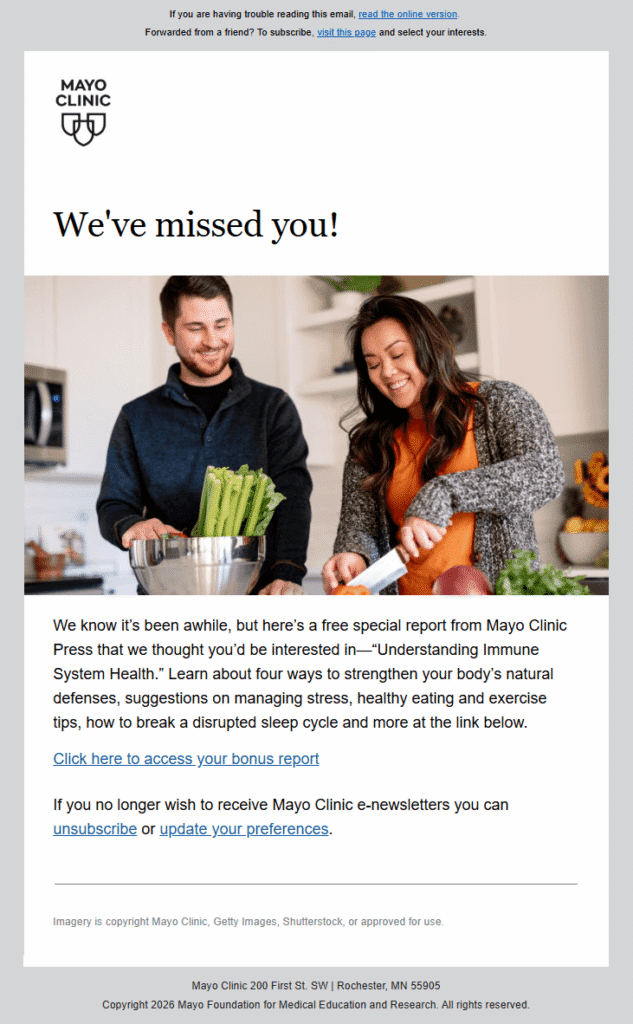
Let Subscribers Choose Their Engagement Preferences
Sometimes subscribers do not want to leave.
They simply want a different relationship with your brand.
This is an important distinction that many marketers overlook.
When engagement declines, companies often assume subscribers are no longer interested. In reality, the issue may be that the current email experience no longer matches their preferences.
For example:
- Email frequency may be too high.
- Content categories may no longer be relevant.
- Messaging may be too promotional.
- Subscriber interests may have changed over time.
Instead of forcing subscribers to choose between staying subscribed and unsubscribing completely, successful brands provide additional options.
This is where preference management becomes extremely valuable.
A preference center allows subscribers to customize how they engage with your emails.
Rather than losing a subscriber entirely, you can give them the flexibility to choose:
- How often they receive emails
- Which content categories interest them
- Whether they prefer promotional or educational content
- Product updates they want to receive
- Topics they wish to follow
For example, a subscriber receiving daily emails may prefer a weekly digest instead.
Another subscriber may want industry insights but have no interest in promotional offers.
Without preference controls, both subscribers might eventually unsubscribe.
With preference options, they can maintain a relationship with your brand on terms that better suit their needs.
Preference management also provides valuable first-party data that helps marketers improve future campaigns.
As privacy regulations continue evolving and third-party tracking becomes less reliable, subscriber-provided preferences are becoming increasingly important for effective personalization.
Many brands now include preference update options directly within re-engagement campaigns.
Instead of asking:
“Do you still want our emails?”
They ask:
“What type of emails would you like to receive?”
That subtle shift changes the conversation from retention to customization.
It empowers subscribers while helping brands preserve valuable relationships.
The Future of Re-engagement Is Relevance
The most effective re-engagement strategies in 2026 share one common principle: relevance.
Generic win-back campaigns often fail because they arrive too late, ignore subscriber intent, and offer little personalized value.
Modern marketers achieve better results by identifying disengagement early, creating highly relevant experiences, and giving subscribers greater control over how they interact with the brand.
Instead of treating re-engagement as a last-ditch effort to rescue inactive subscribers, think of it as an ongoing process of maintaining relevance throughout the customer journey.
When brands focus on delivering value at the right time, to the right person, with the right message, re-engagement becomes far less about winning people back—and far more about keeping them engaged in the first place.
Re-engagement Emails Are Only Part of the Solution
Re-engagement emails remain a valuable tool for reconnecting with subscribers who may have lost focus, become busy, or temporarily drifted away from your brand. They create an opportunity to restart conversations, restore interest, and identify which contacts still want to hear from you.
These campaigns also play an important role in list management. By measuring responses, marketers can separate genuinely interested subscribers from those who are no longer engaged, helping maintain stronger engagement rates and better deliverability over time.
That said, no re-engagement campaign can fully compensate for a weak engagement strategy. Sending a win-back email after months of inactivity may recover some subscribers, but it rarely addresses the underlying reasons they stopped engaging in the first place.
The most successful brands focus on preventing disengagement before it happens. They monitor behavioral signals, personalize experiences, deliver relevant content, and give subscribers greater control over how they interact with emails.
Ultimately, re-engagement emails should be viewed as a safety net rather than the foundation of your email marketing strategy. Long-term success comes from consistently providing value, building stronger subscriber relationships, and staying relevant throughout the customer journey.
FAQs
1. When should you send a re-engagement email?
You should send a re-engagement email as soon as you notice declining engagement rather than waiting until subscribers become completely inactive. The ideal timing depends on your business model and email frequency, but many marketers trigger re-engagement campaigns after 30–90 days of reduced activity.
2. How many re-engagement emails should you send?
Most successful campaigns include a short sequence of two to four emails. This gives subscribers multiple opportunities to reconnect without overwhelming them. Each email should provide value, not simply repeat the same message or offer.
3. What should you do with subscribers who don’t respond?
If subscribers remain inactive after your re-engagement sequence, consider suppressing or removing them from future campaigns. Maintaining a clean email list helps improve deliverability, engagement rates, and overall campaign performance.
4. How do you identify disengaged subscribers?
Disengaged subscribers can be identified through behavioral signals such as declining opens, fewer clicks, reduced website visits, lower purchase frequency, or decreased product usage. Monitoring these trends helps you act before complete disengagement occurs.
5. Are re-engagement emails still worth sending?
Yes. Re-engagement emails remain an effective way to reconnect with interested subscribers and maintain list health. However, they work best when combined with proactive engagement strategies, personalization, and ongoing audience segmentation.