
Email marketing continues to be one of the most resilient and high-performing digital channels globally, and Greece is no exception. Despite the rapid rise of social media platforms, messaging apps, and short-form video content, email remains a central communication tool for businesses aiming to build direct, measurable, and long-term relationships with their audiences.
In the Greek digital ecosystem, email marketing has evolved significantly over the last decade. Businesses are no longer relying on generic bulk campaigns. Instead, they are adopting data-driven segmentation, automation, multilingual personalization, and behavioral targeting to improve engagement rates and conversions.
What makes the Greek market particularly interesting is its blend of mature digital adoption and unique audience characteristics. Greek consumers are highly mobile-first, increasingly comfortable with online shopping, and responsive to personalized communication—especially when it feels relevant and timely.
As email platforms and marketing automation tools become more sophisticated, performance benchmarks in Greece have also shifted. Open rates, click-through rates, and conversion metrics are now more closely tied to content relevance, timing, and audience segmentation rather than sheer sending volume.
This article explores the current state of email marketing growth in Greece, key digital trends shaping performance, and real-world engagement benchmarks observed across campaigns from September 2024 to September 2025.
The Digital Context in Greece
Greece’s digital ecosystem has undergone steady transformation, driven by rising internet penetration, mobile adoption, and increasing reliance on digital communication channels like email. These structural shifts directly influence how email marketing performs across industries.
1. High internet penetration and daily digital usage
Recent data shows that approximately 86%–87% of the Greek population uses the internet regularly, which translates to nearly 9 out of 10 people being active online in some form of digital activity such as email, browsing, or social media engagement .
This high penetration level is important for email marketers because it means:
- Email remains a mass-reach channel
- Most users are digitally reachable without barriers
- Campaign performance depends more on relevance than accessibility
At the same time, Greeks spend an average of 7+ hours per day online, indicating strong digital engagement habits, especially on mobile devices .
2. Strong mobile-first behavior shaping email consumption
Although Greece has a balanced mix of desktop and mobile usage, email engagement is increasingly mobile-dominant in practice.
Key behavioral indicators include:
- Around 65%–67% of email interactions happen on mobile devices
- Mobile email opens continue to grow year over year
- Desktop remains relevant for work-related and long-form email reading
This creates clear implications for email marketers:
- Subject lines must be shorter and highly impactful
- Email layouts must prioritize single-column design
- CTAs must be thumb-friendly and visually prominent
- Heavy visual content can reduce engagement if not optimized
Mobile-first behavior also reduces attention span, meaning users decide within seconds whether to open or ignore an email.
3. Stable but competitive digital environment
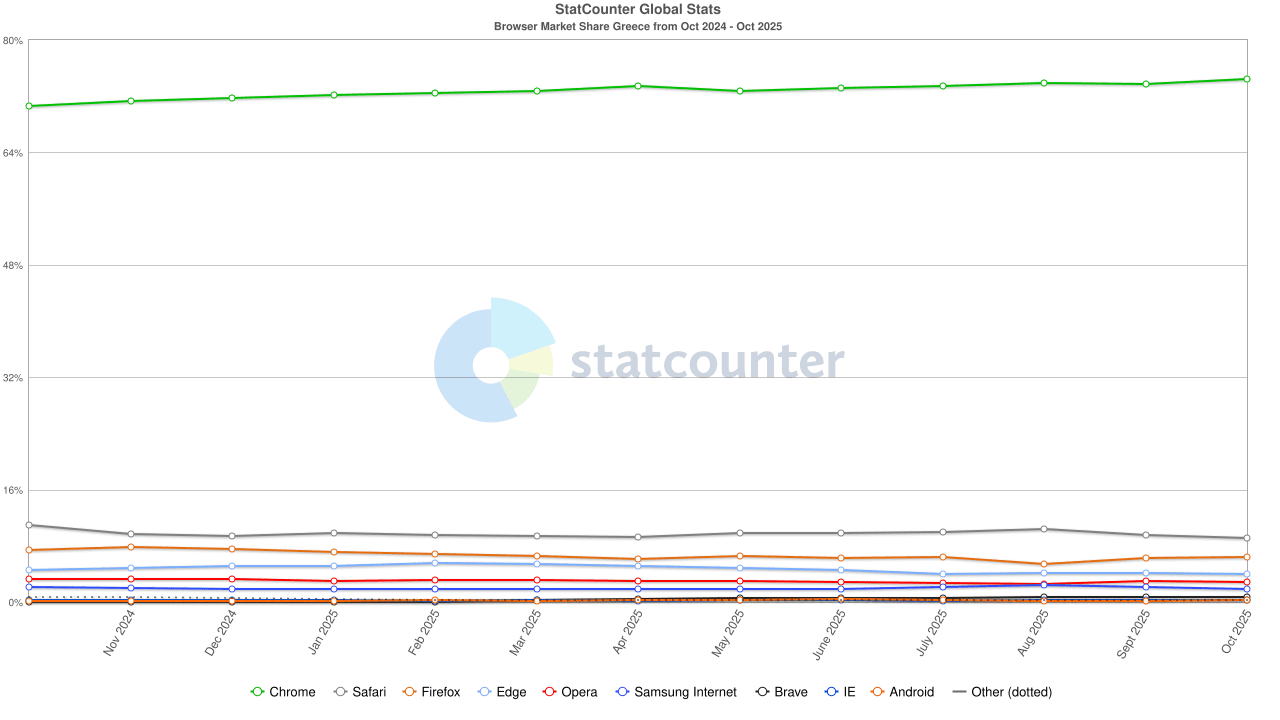
Greece has a relatively stable digital infrastructure in terms of browser and device usage, which benefits email marketers by reducing rendering inconsistencies.
- Chrome dominates browser usage (over 70%)
- Android holds the majority share in mobile OS usage (~70%+)
- iOS users represent a smaller but high-value segment (~20%+)
This consistency ensures that:
- Emails render predictably across devices
- Technical delivery issues are lower compared to fragmented markets
- Marketers can focus more on content and segmentation rather than compatibility issues
4. Increasing email adoption and subscriber growth
Email remains a growing channel in Greece rather than a declining one. Recent estimates show:
- Email subscriber lists are growing at around 12% annually
- Engagement rates are improving due to better targeting and automation
- Businesses are increasingly adopting lifecycle email strategies
This growth is largely driven by:
- Expansion of eCommerce
- Digital transformation in SMEs
- Increased trust in email as a transactional channel
5. Structure over volume
The Greek digital landscape shows a clear shift:
Email performance is no longer driven by how many emails are sent, but by how well they are structured, targeted, and timed.
Brands that rely on mass campaigns typically see diminishing returns, while those adopting segmentation and automation consistently outperform market averages.
Benchmarks: Real Open Rates (Sept. 2024 – Sept. 2025)
Email performance benchmarks in Greece show a clear stratification by industry, audience intent, and trust level. Across multiple datasets, the average open rate in Greece typically falls between 18% and 28%, depending on campaign type and audience quality .
However, performance is far from uniform—some industries significantly outperform this range due to user intent and content relevance.
1. Overall average email performance in Greece
Across aggregated campaign data:
- Average open rate: ~18.5% – 28.4% depending on segmentation quality
- Average click-through rate (CTR): ~2.8% – 4.9%
- Click-to-open rate (CTOR): ~10% – 15% in optimized campaigns
These numbers show a key insight:
Users still open emails at a healthy rate, but converting attention into action remains the biggest challenge.
2. Industry-based open rate benchmarks
Email engagement varies significantly by sector. In Greece, industries can be grouped into three major performance tiers:
🔵 High-performing industries (trust-driven communication)
These sectors consistently achieve the highest engagement:
- Government & public services: ~34%–38%
- Finance & banking: ~30%–37%
- Education: ~28%–36%
- Healthcare: ~29%–34%
Why they perform well:
- Emails are expected (alerts, updates, notifications)
- High trust level between sender and recipient
- Lower promotional noise
👉 Example:
A bank sending account alerts or fraud warnings achieves significantly higher open rates than promotional retail emails because users expect and prioritize these messages.
🟡 Mid-performing industries (balanced engagement)
These industries show moderate but stable performance:
- Travel & hospitality: ~20%–30%
- Media & publishing: ~22%–28%
- Non-profits: ~25%–30%
- Professional services: ~24%–30%
Why they perform moderately well:
- Content is relevant but not always urgent
- Engagement depends heavily on timing (seasonality in travel, news cycles in media)
- Personalization plays a major role
👉 Example:
A travel agency promoting seasonal deals in summer sees significantly higher engagement compared to off-season campaigns.
🔴 Competitive industries (attention-heavy inboxes)
These sectors face the lowest average engagement:
- Retail & eCommerce: ~18%–29%
- SaaS & technology: ~15%–26%
- Telecom: ~16%–25%
- General marketing promotions: ~18%–24%
Why performance is lower:
- High email frequency across brands
- Promotional fatigue among users
- Lower perceived urgency
👉 Example:
An eCommerce brand sending daily discounts competes with dozens of similar offers in the inbox, reducing overall attention.
3. Key benchmark insights (Sept. 2024 – Sept. 2025)
✔ 1. Trust level is the strongest performance driver
Industries with higher trust relationships consistently outperform promotional sectors by 10–15+ percentage points.
✔ 2. Segmentation improves open rates significantly
Well-segmented campaigns outperform generic sends by 10%–20% in engagement metrics, especially in retail and SaaS environments.
✔ 3. Mobile users influence open rate inflation
With 65%+ of email engagement coming from mobile devices, subject line visibility and preview text heavily influence open rates.
✔ 4. Automation boosts engagement consistency
Triggered emails such as:
- Welcome flows
- Abandoned cart reminders
- Post-purchase sequences
typically generate 2–3× higher engagement than standard newsletters.
✔ 5. Click behavior is more important than opens
While open rates average around 18%–28%, click-through rates remain modest at ~3%, showing that:
Engagement quality matters more than raw visibility.
Between September 2024 and September 2025, email marketing in Greece has matured into a precision-driven channel.
The strongest-performing campaigns are no longer those that send more emails—but those that:
- Target the right audience
- Use behavioral triggers
- Deliver mobile-optimized content
- Align messaging with user expectations
Industry Insights: What Works and How Brands Use Email Marketing in Greece
Email marketing in Greece is increasingly driven by automation, personalization, and mobile-first engagement, rather than simple broadcast campaigns. Recent benchmark data shows that the average email performance in Greece has reached a relatively stable but competitive level, with open rates ranging between 18.5% and 28.4% depending on data source and methodology .
At the same time, click-through rates remain modest, averaging around 2.8% to 4.9%, meaning that while users still open emails at a healthy rate, converting attention into action is the main challenge for marketers .
What high-performing email campaigns in Greece do differently
Across industries, the strongest-performing email campaigns in Greece share a few consistent patterns:✔ Trigger-based automation performs better than bulk campaigns
Behavioral emails significantly outperform standard newsletters. These include:
- Abandoned cart reminders
- Welcome email sequences
- Post-purchase follow-ups
- Re-engagement campaigns
Industry data shows that automated and triggered emails can generate 2–3× higher engagement than generic broadcast emails, mainly because they align with user intent and timing.
A major reason for this performance gap is timing relevance—emails sent immediately after user actions consistently achieve higher interaction rates than scheduled newsletters.
✔ Mobile-first optimization dominates engagement
In Greece, email consumption is heavily mobile-driven:
- Around 65%–68% of email interactions occur on mobile devices
- Mobile opens continue to increase year-over-year
This has shifted campaign design priorities significantly:
- Short subject lines (typically under 50 characters)
- Single-column email layouts
- Large CTA buttons optimized for thumb interaction
- Minimal load times and compressed visuals
Campaigns that are not optimized for mobile typically see lower click-through performance even if open rates remain stable.
✔ Trust-based industries outperform transactional sectors
Greek email benchmarks show strong variation by industry:
| Industry | Avg Open Rate |
|---|---|
| Government | ~34–38% |
| Finance & Banking | ~24–37% |
| Education | ~28–36% |
| Retail & E-commerce | ~18–29% |
| SaaS / Tech | ~15–26% |
This distribution highlights a key insight:
The more “expected” or trust-based the email content is, the higher the engagement.
For example:
- Government updates and banking alerts perform strongly because users expect them
- Retail and SaaS emails compete in crowded inboxes, lowering engagement rates
This is why industries with lower open rates must rely more heavily on segmentation and personalization rather than volume.
✔ Personalization significantly increases performance
One of the strongest global and regional trends is the impact of personalization:
- Personalized subject lines can improve open rates by up to 26%
- Segmented campaigns consistently outperform non-segmented campaigns by 10–15%+
In Greece, personalization strategies commonly include:
- First-name or behavior-based subject lines
- Dynamic product recommendations
- Location-based offers (especially tourism-related industries)
- Purchase-history targeting
The key insight is that relevance now matters more than frequency. Sending fewer but more targeted emails often produces better ROI than frequent generic campaigns.
Multilingual audiences & real email engagement in Greece
A defining characteristic of the Greek digital ecosystem is its increasing multilingual audience base, driven by tourism, remote work, and international business expansion.
This creates a dual-language challenge:
- Domestic audiences prefer Greek communication
- International users expect English or multilingual content
However, many brands still operate with a single-language email strategy, which creates engagement inefficiencies.
✔ Language mismatch reduces engagement
Email performance data across multilingual markets shows:
- Language-matched emails consistently improve click-through rates
- Mismatched language communication increases unsubscribe probability
- Even minor localization errors can reduce trust and engagement
In practice, this means:
- A Greek user receiving English-only emails may open fewer campaigns
- International users receiving Greek-only emails often ignore messages entirely
This language friction directly affects conversion performance, not just open rates.
✔ Mobile + multilingual behavior increases segmentation needs
Because mobile usage dominates email interaction in Greece, multilingual segmentation becomes even more important.
Key behavioral patterns include:
- Mobile users scan emails quickly → clarity is critical
- Language confusion leads to instant deletion or ignoring
- Users expect consistent language experience across app, website, and email
This makes segmentation by language a core requirement rather than a “nice to have.”
✔ Tourism and international sectors show strongest multilingual impact
Industries most affected by multilingual email engagement include:
- Tourism and hospitality
- Real estate targeting foreign buyers
- Online education platforms
- SaaS companies targeting EU markets
These sectors often see significantly higher engagement when emails are localized rather than simply translated.
How to target a multilingual audience with email marketing
To maximize engagement in Greece’s multilingual environment, brands must move beyond translation and adopt structured localization strategies.
1. Collect language preference at the point of signup
The most effective segmentation starts during onboarding.
Best practices include:
- Allowing users to choose language during signup
- Auto-detecting language via browser or location
- Providing an option to switch language anytime
This ensures clean segmentation from the beginning of the customer journey.
2. Build separate language-based workflows
Instead of sending one universal campaign, high-performing brands create:
- Greek email workflows
- English email workflows
- Mixed or bilingual fallback sequences
This improves clarity and ensures each audience receives culturally relevant messaging.
3. Localize content beyond direct translation
Effective multilingual email marketing involves adaptation, not just translation.
This includes:
- Currency adjustments (EUR vs international pricing displays)
- Cultural tone adaptation
- Region-specific promotions
- Seasonal relevance (local holidays vs global campaigns)
For example:
- Greek audiences respond better to local seasonal offers
- International users respond better to broader EU travel or product messaging
4. Use behavioral triggers for language-based personalization
Advanced segmentation uses behavior-driven language delivery:
- If a user browses English pages → send English emails
- If purchase history is local → prioritize Greek messaging
- If user switches language on website → adjust email language automatically
This ensures consistency across the entire user journey.
5. Test performance by language segment
One of the most overlooked strategies is A/B testing by language group.
Brands should analyze:
- Open rate differences between Greek and English campaigns
- CTR variation by language group
- Conversion performance per segment
Even small wording differences between languages can produce measurable performance gaps.
6. Align email, website, and product language
The most successful brands ensure full consistency across:
- Website language
- Email communication
- Checkout experience
Any mismatch creates friction and reduces conversion probability.
For example:
- English email → Greek checkout page = drop-offs
- Greek email → English website = confusion
Consistency improves trust, which directly improves conversion rates.
Email marketing in Greece is no longer defined by volume but by precision, personalization, and language alignment. With mobile devices driving most engagement and multilingual audiences expanding, the future of email performance depends heavily on segmentation quality and localized communication strategies.
Brands that adapt to these shifts are already seeing stronger engagement, higher click-through rates, and improved customer retention compared to those relying on traditional one-size-fits-all email campaigns.
Read More: 10 Fashion Newsletter Examples to Inspire Your Next Campaign [2026]