Email marketing continues to outperform every other digital channel heading into 2026—not because it stayed the same, but because it evolved faster than the rest. While social platforms struggle with declining organic reach and paid acquisition costs continue to rise, email remains a direct, permission-based channel that businesses truly own. That ownership is the foundation of its longevity and why email marketing trends for 2026 point toward growth, not decline.
Historically, email has been known for its impressive returns, often cited with an average 36:1 ROI. But in 2026, success is no longer about chasing raw volume or vanity metrics. Instead, the ROI conversation has matured. Marketers are shifting toward smarter ROI—measuring long-term customer value, engagement quality, and revenue attribution rather than inflated open rates. This evolution marks one of the most important differences between email marketing in 2025 vs 2026.
Several major shifts after 2025 reshaped how email works. Privacy changes—led by regulations and inbox-level protections—reduced the reliability of traditional tracking. At the same time, artificial intelligence moved from experimentation to everyday usage, transforming how teams create content, segment audiences, and optimize send times. Deliverability also became more complex, with inbox providers placing greater emphasis on engagement signals, sender reputation, and trust.
Despite these challenges, email continues to outperform social media and paid advertising because it excels where other channels fall short. Email isn’t dependent on algorithms that change overnight. It isn’t limited by third-party data loss. And unlike paid media, results don’t disappear the moment budgets stop. Email compounds over time—building trust, brand recall, and recurring revenue with every meaningful send.
This guide takes a different approach than most trend reports. Instead of focusing only on tools or surface-level tactics, it explores the deeper structural changes shaping the future of email marketing—from privacy-proof strategies and AI-powered workflows to advanced analytics, newsletters, and segmentation. The goal isn’t just to predict what’s next, but to show how marketers can build email programs that thrive in 2026 and beyond.
The State of Email Marketing in 2026
The email marketing industry entering 2026 looks very different from just a few years ago. What was once a channel driven primarily by campaigns and broadcasts has matured into a sophisticated ecosystem built around data, automation, and customer experience. Understanding these shifts is essential for adapting to current email marketing industry trends and staying competitive.
One of the most notable changes is the evolution of the email service provider (ESP) landscape. In 2025, ESPs began moving beyond basic sending functionality, integrating deeper automation, AI-driven personalization, and analytics capabilities. This shift, reflected across email service provider industry news in 2025, has raised expectations for marketers. Email platforms are no longer just delivery tools—they’re becoming central hubs for lifecycle marketing and customer engagement.
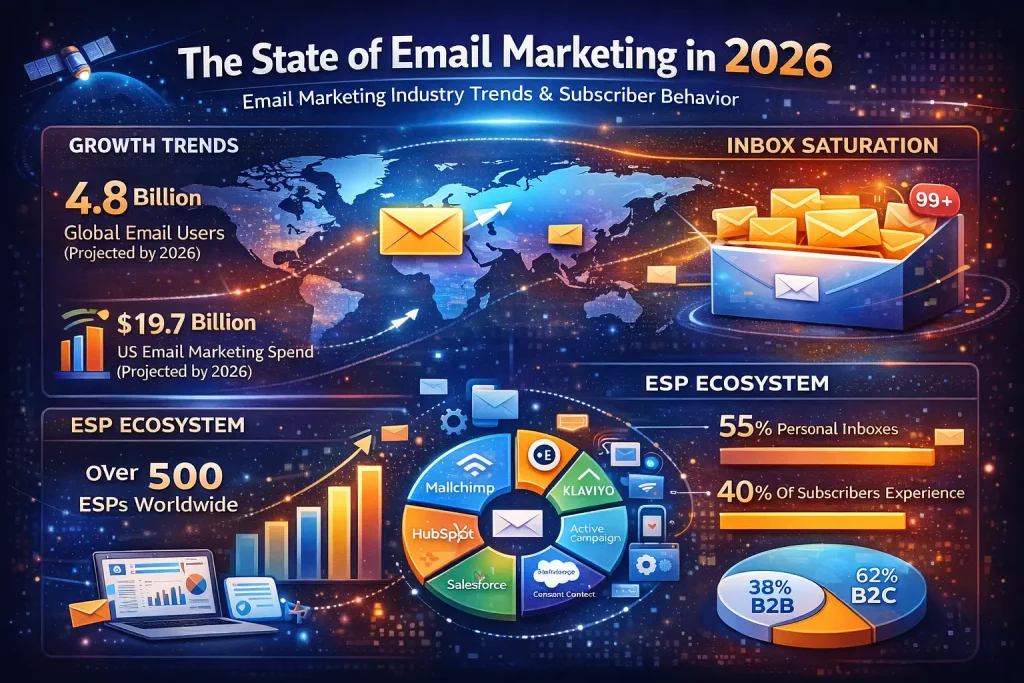
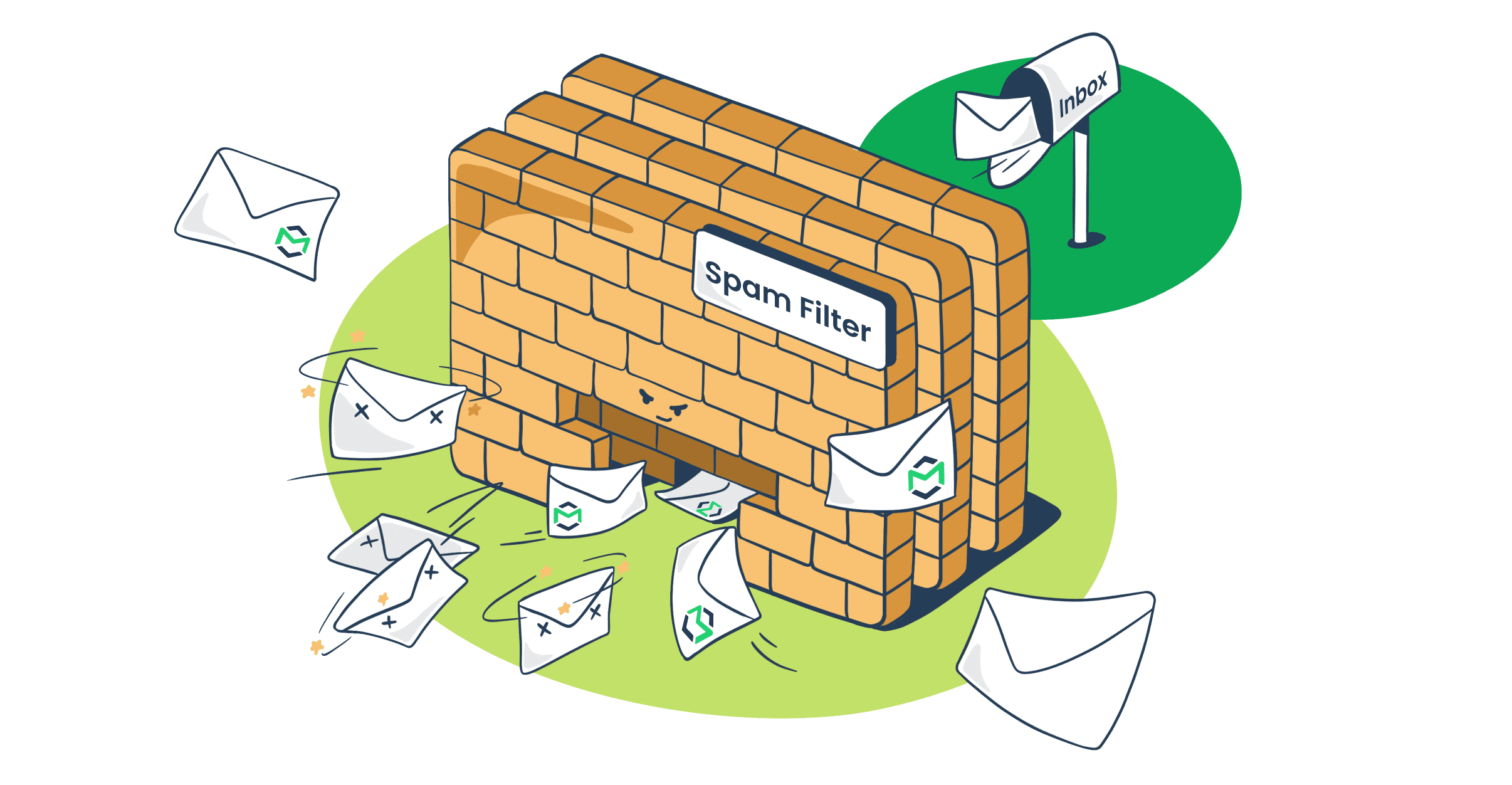
At the same time, inbox competition has intensified. Subscribers receive more emails than ever, leading to engagement fatigue and higher standards for relevance. Inbox providers now prioritize engagement-based signals to determine placement, making it harder for generic or poorly targeted emails to reach the primary inbox. As a result, quality has overtaken quantity as the defining factor of success.
User trust and consent expectations have also increased. Modern subscribers are more aware of how their data is used and more willing to disengage when brands fail to respect their preferences. This has pushed marketers toward transparent data practices, preference centers, and value-driven content strategies. Trust is no longer a soft benefit—it’s a measurable driver of deliverability and long-term performance.
Another defining characteristic of 2026 is the growing divergence between B2B and B2C email strategies. B2B brands are focusing more heavily on education, account-based personalization, and long sales cycles, while B2C brands prioritize retention, real-time personalization, and emotional connection. Although both rely on the same foundational channel, their execution models are increasingly distinct.
Taken together, these shifts illustrate why relying on outdated benchmarks or tactics is no longer viable. The email marketing statistics of 2025 already showed signs of this transformation, but 2026 solidifies it: email success now depends on strategy, trust, and relevance—not just sending more messages.
Trend #1: Privacy-Proof Email Marketing (Beyond Compliance)
Privacy-proofing email marketing in 2026 is no longer about checking regulatory boxes—it’s about building a resilient, trust-based system that performs even as tracking, data access, and inbox rules continue to change. While GDPR, CCPA, and similar regulations laid the groundwork, the next phase of privacy is being shaped by inbox providers, AI legislation, and rising consumer expectations. This shift is already evident across email marketing deliverability news and email deliverability news in 2025, where engagement quality and sender trust are increasingly decisive.
At the core of privacy-proof email marketing is zero-party data—information subscribers intentionally and proactively share. Unlike inferred or third-party data, zero-party data remains reliable even as cookies disappear and open tracking becomes unreliable. Modern zero-party data frameworks rely on preference centers, onboarding surveys, live polls, and progressive profiling. These touchpoints allow brands to understand intent, frequency preferences, and content interests without invasive tracking.
Privacy-proofing also requires strengthening email trust signals. Inbox providers are paying closer attention to authenticated domains, consistent sending behavior, and visual identity indicators. Technologies such as SPF, DKIM, and DMARC are now table stakes, while BIMI (Brand Indicators for Message Identification) is emerging as a competitive advantage. BIMI not only improves brand recognition in the inbox but also reinforces trust—an increasingly important factor in inbox placement and long-term engagement.
Perhaps the biggest mindset shift is recognizing consent as a growth lever, not a limitation. Brands that clearly explain the value of subscribing, offer granular controls, and respect preferences consistently see higher engagement and lower churn. In contrast, aggressive list-building tactics often lead to poor deliverability and declining ROI—undermining the future of email marketing itself.
Privacy-First Email Checklist
- Use double opt-in or confirmation campaigns for list hygiene
- Implement and promote a subscriber preference center
- Collect zero-party data through surveys, polls, and onboarding flows
- Authenticate sending domains (SPF, DKIM, DMARC) and adopt BIMI
- Minimize reliance on personally identifiable information (PII)
- Regularly review consent language and unsubscribe flows
Privacy-proof email marketing isn’t a trend—it’s the foundation of sustainable performance in a world where trust determines visibility.
Trend #2: AI-Powered Email Marketing Becomes the Standard
In 2026, artificial intelligence is no longer a competitive advantage in email marketing—it’s the baseline. What began as simple copy generation has evolved into end-to-end optimization, fundamentally changing how campaigns are planned, executed, and measured. As reflected across AI email marketing trends and generative AI email marketing discussions since 2025, teams that fail to adopt AI thoughtfully risk falling behind both in efficiency and relevance.
AI now supports nearly every stage of the email workflow. At the strategy level, marketers use AI to analyze historical performance, identify audience patterns, and forecast campaign outcomes. For segmentation, machine learning models can dynamically group subscribers based on predicted behavior—such as likelihood to engage, convert, or churn—rather than static rules. Send-time optimization has also become more precise, using behavioral data to deliver emails when each subscriber is most likely to act.
Content creation remains the most visible AI use case, but it has matured significantly. Generative AI assists with subject lines, previews, body copy, and even design layouts—dramatically reducing production time. However, the most effective teams treat AI as a collaborator, not a replacement. Human creativity remains essential for brand voice, emotional resonance, and strategic storytelling—areas where over-automation can quickly backfire.
One of the most powerful applications of AI in 2026 is predictive engagement scoring. Instead of relying on opens or clicks alone, AI models evaluate multiple signals—recency, frequency, device behavior, and historical conversion data—to determine engagement quality. These insights directly impact deliverability, helping marketers suppress disengaged users and prioritize high-intent segments.
Despite its benefits, AI adoption comes with risks. Over-reliance on automation can lead to generic messaging, brand inconsistency, or ethical concerns around transparency and data use. Sustainable AI adoption requires guardrails: clear governance, human review, and ongoing performance validation.
Best practices emerging from marketing trend 2025 and AI marketing trends in June 2025 point to a balanced approach—using AI to scale intelligence and efficiency, while preserving human oversight. In 2026, the brands that win with AI won’t be the ones using it the most, but the ones using it the most intentionally.
Trend #3: Lifecycle Automation Becomes Revenue Infrastructure
By 2026, lifecycle email automation has moved far beyond welcome series and abandoned cart reminders. What was once viewed as a set of efficiency tools is now recognized as a core revenue infrastructure—one that supports acquisition, retention, expansion, and reactivation across the entire customer journey. This evolution is reflected in ongoing email automation trends and reinforced by email marketing ROI statistics from 2025, which show that automated emails consistently outperform one-off campaigns.
Modern lifecycle email marketing is built on automation maturity levels. At the foundational level, brands rely on basic time-based sequences. As maturity increases, automation becomes event-triggered—responding to specific actions such as sign-ups, purchases, or product usage. At the most advanced stage, automation is behavior-driven and predictive, using real-time data and AI signals to anticipate customer needs before they are explicitly expressed.
A key distinction in 2026 is the shift from event-triggered to behavior-triggered flows. Event-triggered emails respond to what just happened; behavior-triggered automations respond to patterns over time. For example, instead of sending a single “check-in” email after inactivity, advanced brands monitor declining engagement signals and dynamically adjust frequency, content type, or offers. This approach feels more personal and drives higher lifetime value without increasing send volume.
Revenue attribution has also become more sophisticated. Rather than crediting only the last email click, teams now evaluate how automated touchpoints influence the entire conversion path. Lifecycle programs—onboarding, education, upsell, and re-engagement—work together to compound results. When properly attributed, automation often accounts for a disproportionate share of email-driven revenue despite representing a smaller percentage of total sends.
In 2026, the most successful teams treat lifecycle automation as a strategic asset. By investing upfront in intelligent triggers, clean data, and ongoing optimization, they build systems that scale revenue while reducing manual effort—turning email from a campaign channel into a long-term growth engine.
Trend #4: The Death of Open Rates & Smarter Analytics
Open rates officially lose their status as a meaningful KPI in 2026. While marketers began questioning their reliability years ago, privacy changes, proxy opens, and inbox-level protections have made them too distorted to guide strategy. Today’s email marketing analytics demand a more accurate, outcome-driven approach—one that connects engagement to real business impact.
The shift away from opens is closely tied to engagement-based deliverability. Inbox providers increasingly evaluate how recipients interact with emails after delivery, not whether an email was technically opened. Metrics such as click depth, read time, replies, forwards, and downstream conversions now play a much larger role in determining inbox placement. This change has forced marketers to rethink how success is defined and reported.
In place of open rates, leading teams are prioritizing engagement quality metrics. Read time helps distinguish between skimmed and genuinely consumed content. Reply rate signals trust and intent, particularly for B2B brands. Conversion rate and revenue per email provide direct links to business outcomes, while unsubscribe and spam complaint rates highlight misalignment with subscriber expectations. Together, these metrics offer a far clearer picture than opens ever could.
Smarter analytics in 2026 also depend on first-party data modeling. With third-party data continuing to erode, brands are investing in systems that unify email engagement, website behavior, product usage, and CRM data. This unified view allows marketers to identify patterns, predict performance, and optimize lifecycle strategies without relying on invasive tracking.
Finally, cross-channel attribution is becoming essential. Email rarely works in isolation—it supports and amplifies content marketing, paid acquisition, and in-product messaging. Advanced analytics models recognize email’s influence across the entire funnel, even when it isn’t the final click. These email marketing updates reflect a broader industry realization: what matters isn’t visibility metrics, but measurable contribution to growth.
Trend #5: Newsletters Become Media Brands
In 2026, newsletters are no longer just a format—they’re becoming media brands in their own right. While promotional emails compete for short-term attention, newsletters win by building habits, trust, and long-term engagement. This evolution is central to emerging email newsletter trends and explains why newsletters consistently outperform other email types on retention.
Modern newsletters succeed because they operate on editorial frameworks, not campaign calendars. Instead of pushing products, they deliver consistent value through insights, stories, curation, or education. This approach aligns with retention psychology: subscribers stay engaged when they know exactly what to expect and why it’s worth opening every time. Over time, this consistency builds brand affinity that transactional emails simply can’t replicate.
Another defining shift is the rise of creator-style newsletters. Brands are adopting a more human voice—often featuring founders, product leaders, or subject-matter experts as recognizable senders. This personal tone increases trust and makes newsletters feel less like marketing and more like a relationship. As inboxes grow more crowded, that sense of connection becomes a powerful differentiator.
Newsletters are also opening new doors for monetization. Beyond driving product revenue, many brands now use newsletters to promote events, premium content, partnerships, or sponsorships. Because newsletter audiences are highly engaged, these monetization models often outperform traditional advertising channels.
Finally, the strongest newsletters foster community-driven engagement. Encouraging replies, featuring subscriber feedback, and highlighting user-generated content transforms newsletters from one-way broadcasts into ongoing conversations. In this context, newsletters aren’t just part of an email marketing content strategy—they are the strategy.
As brands look toward sustainable growth in 2026, newsletters stand out as one of the most effective ways to stay relevant, build trust, and create lasting value in the inbox.
Trend #6: Interactive & Dynamic Email Experiences
By 2026, static emails feel increasingly out of place in the inbox. As subscriber expectations rise and inbox competition intensifies, brands are turning to interactive and dynamic email experiences to capture attention and drive meaningful engagement. What began as an experimental design trend is now a performance strategy directly tied to engagement, deliverability, and conversions.
Interactivity works because it transforms email from a passive message into an active experience. Elements such as live polls, quizzes, countdown timers, image carousels, and embedded video previews invite subscribers to engage without leaving the inbox. These actions send strong engagement signals to inbox providers—signals that increasingly influence inbox placement and sender reputation.
In 2026, the most effective interactive emails rely on dynamic content rather than heavy technical complexity. Real-time elements—such as location-based offers, inventory updates, or personalized recommendations—allow emails to change with every open. This ensures content remains relevant even hours or days after delivery, extending the lifespan and impact of each send.
Email clients still vary in their support for advanced features, which is why successful brands prioritize progressive enhancement. Interactive elements are designed to degrade gracefully, ensuring a functional experience for all subscribers while rewarding modern clients with richer interactions. This balance protects reach while maximizing engagement where possible.
Beyond engagement, interactivity plays a strategic role in data collection. Live polls and feedback widgets generate zero-party data, enabling marketers to refine segmentation, personalize future campaigns, and improve lifecycle automation—all without invasive tracking. For B2C brands, interactivity often drives impulse actions and emotional connection. For B2B brands, it supports education, qualification, and intent signaling.
In 2026, interactive email isn’t about novelty—it’s about relevance. Brands that use dynamic experiences thoughtfully will stand out in crowded inboxes, deepen subscriber relationships, and reinforce the engagement signals that modern deliverability depends on.
Trend #7: Advanced Segmentation & Cross-Functional Alignment Drive Results
Segmentation has long been recognized as one of the most effective email marketing tactics, but in 2026 it has evolved into something far more powerful. Basic demographic or engagement-based segments are no longer enough. Leading brands are embracing advanced segmentation powered by behavioral data, lifecycle context, and cross-functional collaboration.
Modern segmentation strategies move beyond static lists to adaptive audience models. Instead of asking who a subscriber is, marketers focus on what they are likely to do next. Signals such as content consumption patterns, product usage, purchase velocity, and recent engagement trends inform dynamic segments that update in real time. This approach enables emails to stay relevant even as subscriber behavior changes.
One of the most impactful segmentation upgrades in 2026 is lifecycle-based targeting. Rather than treating all subscribers the same, advanced programs align messaging with specific stages—onboarding, activation, growth, retention, or reactivation. Each stage has distinct goals, content needs, and success metrics. When segmentation reflects this reality, email feels timely instead of intrusive.
Segmentation also performs best when it extends beyond the marketing team. Cross-functional alignment is becoming a defining characteristic of high-performing email programs. Customer success teams contribute insights into churn risks and feature adoption. Sales teams inform messaging around objections and timing. Product teams share usage data that signals readiness for education or upsell. When these inputs are unified, email becomes a shared growth channel rather than a siloed tactic.
Importantly, advanced segmentation improves more than engagement—it improves trust. Subscribers receive fewer irrelevant messages and more content that aligns with their needs and intent. This reduces fatigue, lowers unsubscribe rates, and strengthens long-term deliverability.
In 2026, the brands that win with email won’t be the ones sending more—they’ll be the ones sending smarter. Advanced segmentation, supported by cross-team collaboration, turns email into a precision tool for retention, revenue, and customer experience.
What’s Next: Email Marketing Trends Beyond 2026
Looking beyond 2026, the future of email marketing will be shaped less by individual tactics and more by systemic change. As inbox providers, regulators, and consumers continue to raise expectations, email will evolve into an even more trust-driven and intelligence-led channel.
One of the biggest forces influencing email marketing trends in 2027 will be AI regulation. As governments move to define acceptable AI use, marketers will need to ensure transparency, consent, and explainability in how AI influences content, personalization, and decision-making. Brands that proactively align with these standards will avoid disruption while reinforcing trust with subscribers.
Inbox algorithms will also continue to advance. Rather than relying on basic engagement signals, inbox providers are expected to evaluate holistic user behavior—including reading depth, interaction frequency, and long-term sender relationships. This means that short-term engagement hacks will become increasingly ineffective, while consistent value delivery will be rewarded with better visibility.
Another major email trend is the convergence of email with other messaging channels. Email will increasingly act as the anchor of a broader owned-media ecosystem, working alongside SMS, in-app messaging, and push notifications. Instead of competing, these channels will coordinate—using email for depth, context, and storytelling, while real-time channels handle urgency.
Ultimately, the brands that succeed beyond 2026 won’t treat email as a legacy channel. They’ll treat it as a flexible, evolving platform—one that adapts to regulation, technology, and human behavior while remaining rooted in permission and trust.
Actionable Checklist: How to Win Email Marketing in 2026
Turning trends into results requires execution. This checklist summarizes email marketing best practices for 2026 and provides a practical framework for building a resilient, high-performing email marketing strategy.
Strategy
- Shift focus from volume to long-term customer value
- Align email goals with lifecycle stages and business outcomes
Technology
- Choose an ESP that supports automation, AI, and advanced analytics
- Enable real-time and dynamic content capabilities
Data
- Prioritize first-party and zero-party data collection
- Move beyond open rates to engagement and revenue metrics
Content
- Balance AI-assisted creation with human oversight
- Invest in newsletters and educational content, not just promotions
Deliverability
- Authenticate sending domains (SPF, DKIM, DMARC)
- Monitor engagement signals and suppress inactive subscribers
- Use preference centers to reduce fatigue and build trust
In 2026, winning with email isn’t about doing more—it’s about doing the right things consistently, with intention and intelligence.
Conclusion: Email Isn’t Dying—It’s Evolving
Email marketing has survived every major shift in digital marketing because it adapts. As we move into 2026 and beyond, that adaptability is more important than ever. Privacy changes, AI adoption, smarter analytics, and evolving inbox algorithms aren’t signs of decline—they’re signals of maturity.
The most successful email programs are no longer built on shortcuts or outdated metrics. They’re built on trust, relevance, and long-term value. Marketers who embrace privacy-proof strategies, intelligent automation, meaningful engagement metrics, and content-first thinking will continue to see email outperform newer, more volatile channels.
Email isn’t competing with social media, paid ads, or messaging platforms—it’s complementing them. As the backbone of owned marketing, email remains uniquely positioned to build relationships that compound over time.
The future of email marketing belongs to brands that adapt proactively rather than reactively. Those willing to rethink how they measure success, how they use technology, and how they respect their audience won’t just keep up with change—they’ll lead it.