
Modern professionals have access to more information than at any point in history. Dashboards update in real time, AI tools generate endless reports, and every decision can be supported by another layer of metrics. On the surface, this seems like an advantage. More data should lead to smarter choices. Yet in many cases, the opposite happens.
Instead of improving confidence, too much information can create hesitation. People begin comparing every possible scenario, questioning every assumption, and searching for one more insight before taking action. What starts as responsible decision-making can slowly become a cycle of delay. This pattern is known as analysis paralysis — a state where excessive thinking prevents meaningful progress.
In 2026, this problem has become even more common because decision-making now happens in a world shaped by:
- Constant streams of performance data
- AI-generated recommendations
- Multiple software tools reporting different metrics
- Pressure to justify every decision with evidence
- Fear of making the wrong move publicly
Many individuals believe they need complete certainty before acting. The problem is that certainty rarely arrives. New data often creates new questions, and the search for the “perfect” answer can become endless.
Analysis paralysis affects both individuals and organizations. A business may delay launching a campaign because teams keep reviewing numbers. A manager may postpone hiring because every candidate seems to have trade-offs. A person may struggle to make personal decisions because too many choices feel equally risky.
Research in behavioral psychology continues to show that too many options can reduce satisfaction and make decisions harder, not easier. Instead of clarity, excess information can create mental overload, stress, and indecision.
Understanding why this happens is important because success often depends less on having more information and more on knowing when enough information is enough.
What Does Analysis Paralysis Mean?
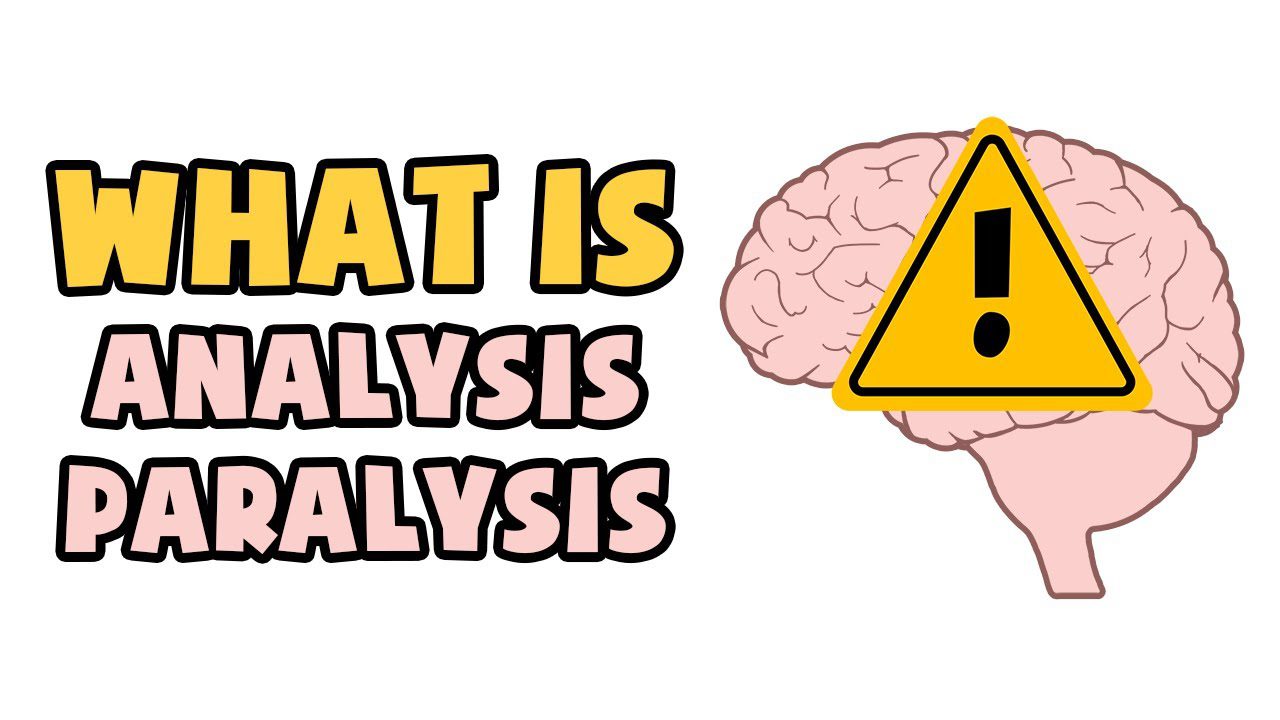
Analysis paralysis refers to a situation where overthinking prevents a person from making a decision. Rather than moving forward after reviewing the available information, the mind keeps searching for additional data, better options, or stronger validation until action stops completely.
At its core, analysis paralysis is not simply careful thinking. Healthy analysis helps people evaluate risks and choose wisely. Analysis paralysis happens when that process becomes excessive and unproductive.
A person experiencing analysis paralysis may:
- Repeatedly review the same information
- Compare too many alternatives
- Fear choosing the wrong option
- Delay action despite having enough evidence
- Seek endless reassurance from others
- Feel mentally exhausted without making progress
For example:
A marketer may spend weeks reviewing campaign data before changing a subject line.
A business owner may research software tools for months without selecting one.
A student may delay choosing a career path because every option feels imperfect.
In each case, the issue is not a lack of intelligence. The problem is that the decision process becomes larger than the decision itself.
Several psychological factors can contribute to this pattern, including:
- Fear of making mistakes: People often believe one wrong choice could create major consequences, so they avoid deciding altogether.
- Perfectionism: Some individuals feel every decision must be optimal rather than simply effective.
- Information overload: Too much data can overwhelm the brain’s ability to prioritize what matters most.
- Low confidence: When people do not trust their judgment, they rely too heavily on external input.
- Choice overload: Having more options can make every option seem less clear.
In today’s environment, analysis paralysis is becoming more visible because technology makes it easy to gather unlimited information. AI tools can now generate multiple perspectives instantly, which can be useful, but they can also make simple decisions feel unnecessarily complex.
The key difference is this:
| Healthy Analysis | Analysis Paralysis |
|---|---|
| Supports action | Prevents action |
| Clarifies choices | Complicates choices |
| Uses relevant data | Chases endless data |
| Builds confidence | Creates doubt |
Analysis itself is not the problem. The real issue begins when thinking replaces action. When that happens, more information no longer improves the decision — it simply delays it.
Who Is Most Prone to Analysis Paralysis?
Analysis paralysis doesn’t affect everyone equally. While anyone can experience it under pressure, certain personality traits, roles, and environments make it far more likely. In today’s data-heavy, performance-driven world, these patterns are becoming increasingly common.
A perfectionist
Perfectionists are among the most vulnerable. They often believe every decision must be the “best possible” one, not just a good or workable choice. This mindset creates constant pressure to gather more data, compare more options, and eliminate every possible risk. The problem is that perfection rarely exists. As a result, decisions get delayed indefinitely because nothing feels “good enough.”
Working in a high-pressure environment
Fast-paced workplaces—especially in marketing, tech, or leadership roles—amplify decision stress. When outcomes are visible, measurable, and tied to performance, individuals feel a stronger need to justify every move. This pressure increases overthinking and reduces the willingness to act with incomplete information.
Responsible for big or important decisions
The higher the stakes, the harder it becomes to decide. Career moves, financial investments, or strategic business choices often trigger analysis paralysis because the consequences feel long-term or irreversible. Fear of making the wrong call can outweigh the benefits of making any decision at all.
Managing many decisions at once
Modern professionals rarely deal with one decision at a time. Instead, they juggle dozens daily. Over time, this leads to mental fatigue. When cognitive resources are drained, even simple decisions begin to feel overwhelming, increasing the likelihood of avoidance or delay.
Surrounded by too much data
Access to unlimited information is one of the biggest modern triggers. When dashboards, reports, and AI insights continuously generate new data, it becomes difficult to identify what actually matters. Instead of clarity, people experience overload—where more information leads to more confusion, not better decisions. Research shows that excessive information and options can overwhelm cognitive capacity and stall decision-making.
Analysis paralysis tends to affect those who are driven, responsible, and surrounded by complexity—the very people expected to make the best decisions.
The True Causes of Analysis Paralysis

Understanding who is affected is only part of the picture. The deeper issue lies in why analysis paralysis happens. It is rarely caused by laziness or lack of skill. Instead, it emerges from a combination of psychological patterns, workplace pressures, and modern digital environments.
1. Perfectionism disguised as caution
One of the most common causes is perfectionism—but it rarely appears in an obvious form. Instead, it disguises itself as being “careful,” “strategic,” or “data-driven.”
At first glance, spending extra time analyzing options seems responsible. But the underlying motivation is often the desire to avoid mistakes completely. People begin to believe that if they collect enough data, they can eliminate uncertainty.
The reality is different. No decision is ever risk-free.
Perfectionism shifts the goal from making a good decision to making a flawless decision. This creates an impossible standard. As a result, even simple choices become complex because they must meet unrealistic expectations.
Over time, this leads to:
- Endless research cycles
- Difficulty committing to a direction
- Constant second-guessing
Studies show that when individuals expect decisions to be perfect, even minor choices can feel overwhelming.
What looks like caution is often fear in disguise.
2. The pressure to prove performance
In 2026, decisions are rarely private. Every action can be tracked, measured, and evaluated. This has fundamentally changed how people approach decision-making.
Instead of asking, “What’s the best move?”, many people now ask, “How will this decision be judged?”
This pressure creates a need for justification. People feel they must support every decision with data, metrics, and evidence. While data can improve decisions, the need to prove decisions often slows them down.
Common effects include:
- Over-reliance on reports and dashboards
- Fear of making decisions without “enough” data
- Delayed action while waiting for more validation
In performance-driven environments, making no decision can feel safer than making the wrong one. This creates a culture where analysis replaces action.
Ironically, this reduces performance over time. Opportunities are missed, speed is lost, and competitors move faster.
3. Too many options and the paradox of choice
Having more options should make decisions easier—but research shows the opposite can happen.
This phenomenon is known as the paradox of choice, where an abundance of options leads to stress, indecision, and reduced satisfaction.
When faced with too many choices:
- The brain struggles to compare all alternatives
- Decision time increases significantly
- Doubt and second-guessing intensify
Instead of feeling empowered, people feel overwhelmed. Even after making a decision, they may question whether a better option existed.
Psychological research also shows that our brains are not designed to efficiently process large numbers of choices. Too many options can become a mental drain, making it harder to act.
This is why more options often lead to less action, not more.
4. Imposter syndrome and external validation
Another powerful but often hidden cause is imposter syndrome—the feeling that one’s judgment is not reliable enough.
When people doubt their own expertise, they seek reassurance from external sources:
- More data
- More opinions
- More validation
This creates a loop where decisions are constantly postponed in search of confirmation.
Instead of trusting their experience, individuals rely heavily on:
- Peer opinions
- Industry benchmarks
- AI recommendations
While these inputs can be useful, over-reliance reduces confidence. Every new piece of information introduces new uncertainty, making it harder to decide.
Research shows that anxiety and self-doubt can significantly increase overthinking and hesitation in decision-making.
The result is not better decisions—but delayed ones.
5. The illusion of perfect attribution
In modern analytics-driven environments, there is a strong belief that every outcome can be traced back to a clear cause.
People assume:
- There is always a “correct” answer hidden in the data
- With enough analysis, the best decision will become obvious
- Every result can be perfectly explained
This creates what can be called the illusion of perfect attribution.
In reality, most decisions involve uncertainty, incomplete data, and multiple influencing factors. Outcomes are rarely as predictable as they seem.
However, the belief in perfect attribution leads to:
- Endless data analysis
- Overcomplication of simple decisions
- Difficulty accepting uncertainty
Instead of making a decision and learning from the result, people stay stuck trying to guarantee the result beforehand.
This is where analysis becomes counterproductive. The pursuit of certainty delays progress.
6. AI burnout and cognitive overload
One of the newest causes of analysis paralysis is the rise of AI-driven tools.
AI has made it easier than ever to generate insights, predictions, and recommendations. But this convenience comes with a cost: information overload at scale.
Instead of struggling to find answers, people now struggle to filter them.
AI contributes to analysis paralysis in several ways:
- Producing multiple possible solutions instantly
- Generating conflicting recommendations
- Encouraging constant iteration and refinement
This leads to cognitive overload, where the brain becomes overwhelmed by the volume of input. Research shows that too much information and too many variables can exceed cognitive capacity, resulting in decision fatigue and inaction.
Over time, this creates what can be described as AI burnout:
- Mental exhaustion from constant analysis
- Reduced ability to prioritize
- Difficulty committing to decisions
Instead of simplifying decision-making, excessive AI use can sometimes complicate it.
Bringing It All Together
Analysis paralysis is not caused by a single factor. It is the result of multiple forces working together:
- The desire to be perfect
- The pressure to prove decisions
- The overload of choices
- The lack of confidence
- The illusion of certainty
- The explosion of data and AI
Individually, each factor seems logical. Combined, they create a system where thinking never ends—and action never begins.
How to Overcome Analysis Paralysis When You Feel Stuck

Breaking out of analysis paralysis isn’t about eliminating thinking—it’s about making thinking useful again. In 2026, with constant data streams and AI-generated insights, the goal is not to gather more information but to create structure around decisions. The following strategies are practical, research-backed, and designed for real-world decision-making.
Define the decision before you look for answers
One of the biggest mistakes people make is jumping into research without clearly defining what they’re trying to decide. This leads to scattered information, conflicting insights, and unnecessary complexity.
Instead, start by asking:
- What exactly am I deciding?
- What outcome do I want?
- What constraints matter (time, budget, risk)?
When you define the decision first, you create a filter for information. This makes it easier to ignore irrelevant data and focus only on what supports the decision.
Experts recommend identifying what you know vs. what you need to know to avoid endless research loops.
Without this clarity, you’re not analyzing—you’re just collecting information with no direction.
Limit external input
More input doesn’t always mean better decisions. In fact, too many opinions, reports, and data sources often create confusion rather than clarity.
In modern workflows, people are surrounded by:
- Dashboards and analytics tools
- AI-generated recommendations
- Peer opinions and industry benchmarks
While each source can be helpful, combining all of them at once leads to information overload. Research shows many leaders are overwhelmed by irrelevant or duplicative data, which slows decision-making.
To overcome this:
- Choose 2–3 trusted sources of input
- Ignore non-essential metrics
- Avoid seeking validation from too many people
This doesn’t mean ignoring data—it means curating it intentionally. The goal is clarity, not volume.
Use deadlines
A decision without a deadline is a decision that can be delayed indefinitely.
Deadlines create urgency and force prioritization. When you know you must decide within a specific timeframe, your brain shifts from endless exploration to focused evaluation.
Research and workplace insights consistently show that setting time limits helps reduce overthinking and improves decision efficiency.
Practical ways to apply this:
- Set a hard deadline for final decisions
- Use time blocks for analysis (e.g., 30–60 minutes)
- Separate thinking time from action time
Some experts suggest using “decision minimums”—deciding with the least amount of information needed for a reasonable choice.
Here’s a simple example:
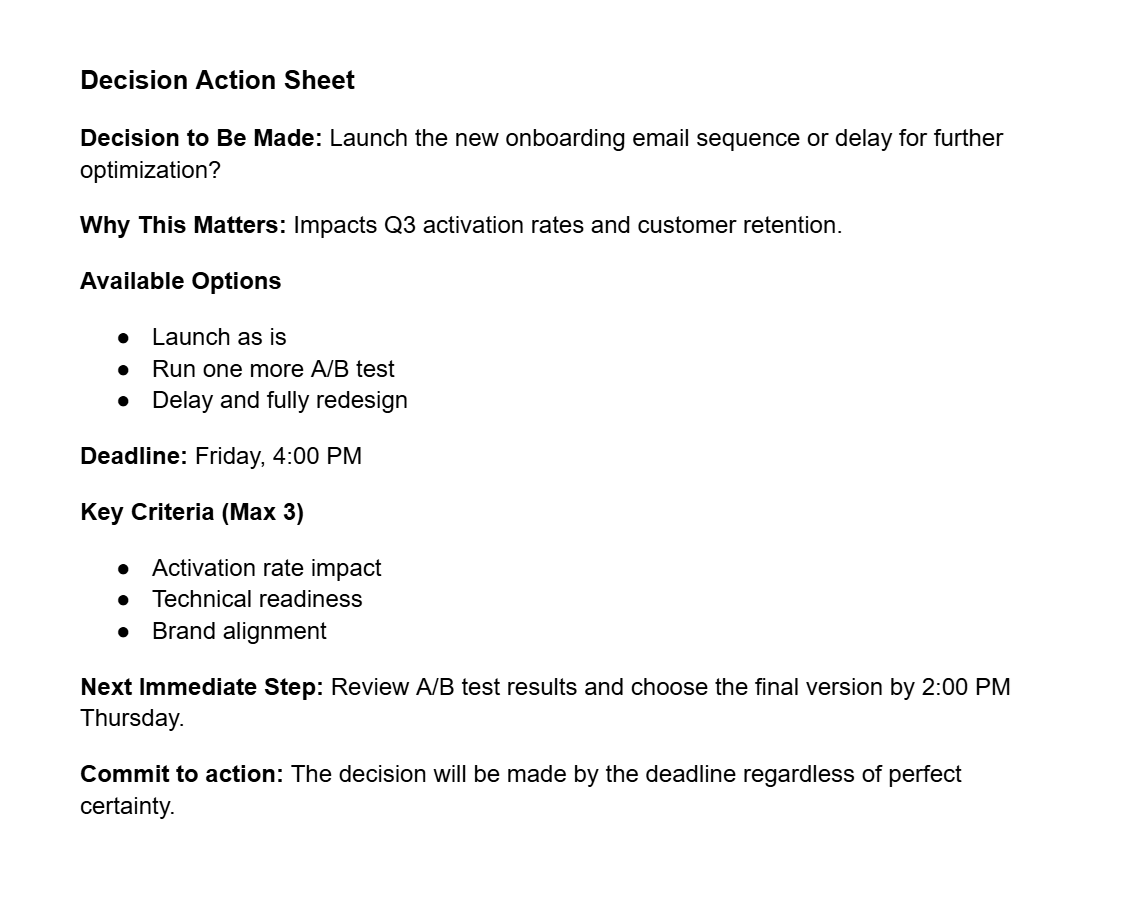
Deadlines don’t guarantee perfect decisions—but they guarantee progress.
Trust patterns over isolated outcomes
One of the reasons people get stuck is because they focus too much on individual data points instead of broader patterns.
For example:
- One failed campaign doesn’t define a strategy
- One data spike doesn’t represent a trend
- One opinion doesn’t reflect reality
When you rely on isolated outcomes, every new piece of information can change your direction. This leads to constant hesitation.
Instead, focus on:
- Repeated trends over time
- Consistent patterns in data
- Long-term signals rather than short-term noise
Experienced decision-makers understand that patterns are more reliable than single data points. This reduces the need for constant re-analysis.
Additionally, accepting that decisions are based on incomplete but sufficient information helps build confidence. High-performing leaders often make decisions with the best available data—not perfect data—and adjust as they learn.
Healthy Analysis Over Paralysis
Healthy analysis is not about avoiding thinking—it’s about knowing when thinking has done its job. Effective decision-making involves gathering relevant information, evaluating realistic options, and then moving forward with confidence. The key difference is that healthy analysis supports action, while analysis paralysis delays it. Research shows that overthinking often comes from the fear of making mistakes or missing a better option, which can stop decisions entirely .
In contrast, healthy analysis accepts that uncertainty is unavoidable and focuses on making the best possible decision with available information. It also recognizes diminishing returns—after a certain point, more data adds complexity rather than clarity. Strong decision-makers set boundaries, prioritize what matters, and act before overanalysis takes over. Ultimately, healthy analysis is about balance: thinking enough to make informed choices, but not so much that progress comes to a halt.