In today’s digital landscape, email marketing isn’t just alive — it’s one of the most reliable and effective marketing tools available. Even with the rise of social media, chat apps, and emerging technologies, email remains a cornerstone of successful digital strategies. That’s because email gives businesses a direct, measurable, and cost-effective way to communicate with both prospects and loyal customers. Unlike rented audiences on social platforms or fleeting SEO rankings, your email list is something you own outright — making it a powerful asset for long-term engagement, retention, and revenue growth.
Across industries and company sizes, email continues to outperform many other marketing channels in terms of return on investment (ROI), engagement, personalization, and customer lifetime value. Organizations that use email strategically — from welcome series to automated segmentation — enjoy stronger conversions, clearer performance insights, and deeper customer relationships.
Email is more than just a communication tool. It’s a proven business driver that delivers measurable results and scalability year after year.
Just How Valuable Are Email Marketing Campaigns?

Email marketing’s value isn’t theoretical — it’s supported by strong data and real business outcomes. Whether you’re pitching the idea to leadership, securing budget for tools and talent, or comparing channels, email’s performance speaks for itself.
📈 Unmatched Reach and Ubiquity
Today, billions of people actively use email — far more than most social networks combined. In 2025, the number of global email users reached approximately 4.6 billion, which is more than half the world’s population. This broad reach means your campaigns can target nearly any audience demographic, location, or interest group.
Additionally, email isn’t just a broadcast channel — most users check their inbox daily, offering habitual visibility marketers can reliably count on.
💰 Exceptional ROI
One of the strongest arguments for email marketing is its extraordinary return on investment. Multiple industry benchmarks show that email generates between $36 and $42 for every $1 spent — translating into a 3,600% to 4,200% ROI. This performance consistently surpasses most other digital marketing channels, including paid advertising, social media, and more.
In some specific segments, like e-commerce, well-optimized email campaigns can drive even higher returns, especially when automation is put to work.
🎯 Targeted and Personalized Engagement
One of email’s biggest strengths is how deeply you can tailor your messaging. Through list segmentation and behavioral tracking, you can send:
-
Personalized offers based on past purchases
-
Content tailored to specific interests
-
Time-sensitive messages like cart reminders
Highly targeted campaigns not only increase relevance but also drive stronger engagement — meaning higher opens, clicks, and conversions. This ability to personalize at scale is superior to many one-size-fits-all channels like display ads or general social feeds.
📊 Measurable and Optimizable Performance
With email marketing platforms, every campaign is trackable. Marketers can measure essential metrics such as:
-
Open rates
-
Click-through rates
-
Conversion rates
-
Revenue per recipient
This level of measurement enables data-driven optimization, continual performance improvement, and clear accountability for every dollar spent.
🔁 Automation and Lifecycle Marketing
Modern email tools let you automate complex customer journeys — from welcome series and onboarding to cart abandonment and post-purchase follow-ups. These automated flows often produce higher engagement and revenue than standard newsletters because they reach users with the right message at the right time.
🔐 Customer Ownership
Unlike social platforms where visibility is controlled by changing algorithms, your email list is an owned audience — meaning you’re not at the mercy of third-party platforms. This ownership ensures long-term access to your subscribers, protects your reach, and gives you full control over how and when you communicate with your audience.
Email marketing’s value isn’t just anecdotal — it’s quantifiable, scalable, and often the most cost-efficient driver of revenue and engagement available to businesses today. Whether you’re trying to build awareness, nurture leads, or retain customers, email stands as one of the most effective tools in your digital marketing arsenal.
Why is email marketing so much more effective than other mediums?
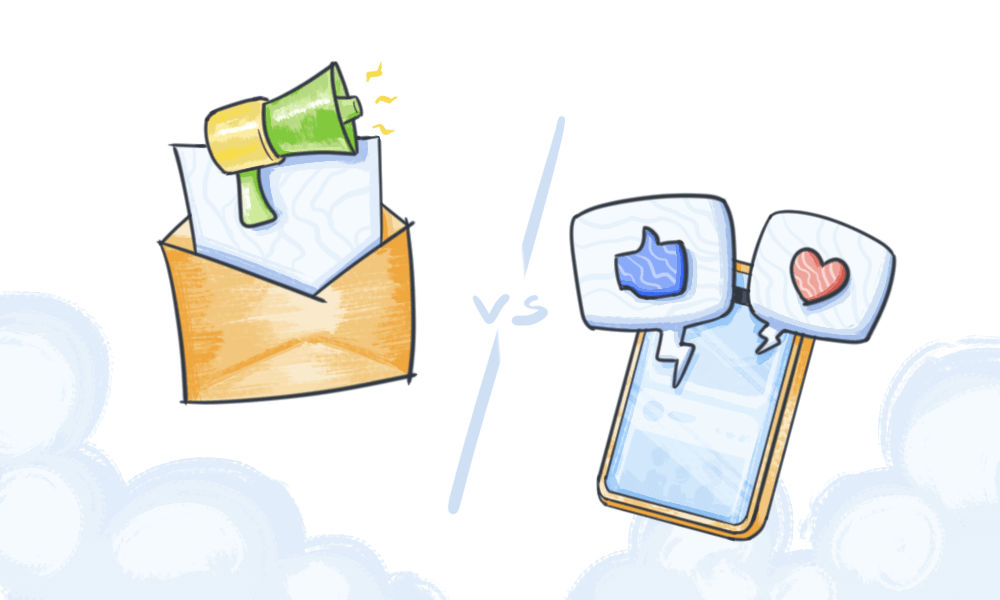
Email marketing continues to outperform many other digital channels—not because it’s trendy, but because it’s strategically powerful, deeply measurable, and built on ownership rather than algorithms. When you’re advocating for its value internally, the key is to show why email consistently delivers stronger ROI, engagement, and long-term growth compared to paid ads or social media.
Here’s what sets it apart.
Easy to personalize
Modern email marketing is far removed from generic mass blasts. Today’s platforms allow you to segment audiences based on:
-
Purchase history
-
Website behavior
-
Engagement patterns
-
Demographics
-
Lifecycle stage
This enables brands to deliver highly targeted, relevant messaging at scale.
For example, instead of sending the same promotional message to 100,000 subscribers, you can send:
-
A re-engagement offer to inactive subscribers
-
A product recommendation to recent buyers
-
A reminder to someone who abandoned their cart
-
A loyalty incentive to repeat customers
Personalization increases open rates, click-through rates, and revenue because it makes the content feel timely and relevant. When subscribers see messaging that reflects their interests and behavior, they’re far more likely to respond.
Research consistently shows that segmented campaigns drive significantly higher revenue compared to non-segmented campaigns. This level of precision is difficult to replicate on social platforms, where algorithms—not your strategy—largely control visibility.
Email gives you direct access and control over who receives what message and when.
Reaches mobile devices
More than half of emails are opened on mobile devices. For many users, checking email is a daily habit—often multiple times per day.
Unlike social media posts that may disappear quickly in a fast-moving feed, emails remain in the inbox until they’re read, archived, or deleted. That persistence increases the likelihood of visibility.
Mobile optimization has also made email far more accessible. Responsive templates, concise formatting, and clear calls to action ensure messages perform well across smartphones, tablets, and desktops.
Additionally, email notifications act as built-in reminders. When a new message arrives, users receive a prompt—something you don’t always get with social content unless someone happens to be actively scrolling.
Email travels with your audience. It doesn’t depend on timing alone—it benefits from routine.
Integrates into your broader marketing plan
Email is rarely a standalone tactic. Its real power emerges when it’s integrated into your larger marketing ecosystem.
Email supports and strengthens:
-
Content marketing (newsletter distribution, blog promotion)
-
Lead nurturing (educational drip campaigns)
-
E-commerce (abandoned cart, product recommendations)
-
Event marketing (reminders and follow-ups)
-
Customer onboarding (welcome sequences)
-
Retention and loyalty campaigns
It also complements paid advertising. For example:
-
Use paid ads to capture leads.
-
Use email to nurture them.
-
Use retargeting ads to re-engage non-clickers.
-
Use email again to close the sale.
This multi-channel reinforcement increases conversions dramatically.
Unlike social platforms, where engagement often ends once the post disappears, email builds ongoing relationships. Automated lifecycle campaigns ensure prospects and customers receive the right message at every stage—from awareness to retention.
That strategic integration is one of email’s biggest competitive advantages.
Cost-effective
One of the strongest arguments for email marketing is its return on investment.
Industry benchmarks regularly report ROI figures ranging from $36 to $42 for every $1 spent. Very few channels can match that level of efficiency consistently across industries.
Email marketing costs are relatively predictable:
-
Platform subscription fees
-
Creative and copywriting resources
-
Strategy and segmentation planning
There are no fluctuating bidding wars like in paid search or social advertising. You’re not competing against others for visibility inside the inbox in the same way you compete for ad impressions.
Additionally, once automated workflows are built—such as welcome sequences, cart abandonment emails, or re-engagement campaigns—they continue generating revenue with minimal ongoing cost.
This scalability makes email particularly attractive to leadership teams focused on performance efficiency.
Easily trackable
Email marketing provides clear, measurable data that helps prove impact.
You can track:
-
Open rates
-
Click-through rates
-
Conversion rates
-
Revenue per campaign
-
Revenue per subscriber
-
Subscriber growth
-
Unsubscribe rates
-
Engagement over time
With proper tracking and integration with analytics platforms, you can attribute revenue directly to specific campaigns.
This transparency makes email easier to justify internally compared to channels where attribution is murkier.
You can also continuously optimize performance through:
-
A/B testing subject lines
-
Testing send times
-
Testing CTA placement
-
Comparing segmentation strategies
Email isn’t guesswork—it’s a channel driven by data and continuous improvement.
When advocating for budget or resources, the ability to show measurable impact strengthens your case significantly.
FAQs about starting an email marketing strategy (and how to answer them)
When proposing or expanding an email marketing initiative, you’re likely to encounter skepticism. Here’s how to respond strategically and confidently.
“It’s just email — why should we spend more time and money on it?”
This objection usually comes from underestimating what modern email marketing actually is.
It’s not “just email.” It’s:
-
A direct communication channel you own
-
A high-ROI revenue driver
-
A lifecycle automation engine
-
A retention and loyalty tool
-
A measurable performance channel
Email supports every stage of the customer journey:
-
Awareness (educational content)
-
Consideration (case studies, offers)
-
Conversion (promotions, reminders)
-
Retention (exclusive benefits)
-
Advocacy (referral programs)
Unlike social media, where reach depends on algorithms, email ensures your message reaches subscribers directly.
When framed as a strategic revenue and retention channel—not merely a communication tool—the investment makes sense.
“Can’t we get the same results from social?”
Social media plays an important role—but it’s fundamentally different.
Here’s the distinction:
Social media = rented audience.
Email = owned audience.
On social platforms, algorithm changes can drastically reduce your organic reach overnight. Even paid ads depend on fluctuating costs and competition.
Email, however, gives you:
-
Direct access to subscribers
-
Greater control over messaging
-
More consistent visibility
-
Better conversion rates in many industries
Additionally, email often drives stronger intent. Someone who subscribes has explicitly opted in to hear from your brand.
Email and social shouldn’t compete—they should complement each other.
Use social to grow your audience.
Use email to deepen relationships and drive conversions.
“How do I know it’s email driving results as opposed to some other random factor?”
This is a fair question—and one you can answer with data.
Email platforms allow detailed tracking and attribution. You can:
-
Use unique tracking links
-
Monitor campaign-specific revenue
-
Track assisted conversions in analytics tools
-
Compare behavior of email subscribers vs. non-subscribers
-
Conduct A/B tests to measure impact directly
For example, send a promotional offer to one segment while holding back a control group. Compare conversion rates.
This experimental approach isolates the effect of email.
Unlike traditional media channels, email provides measurable cause-and-effect data.
That level of accountability strengthens your internal advocacy significantly.
“I get hundreds of emails every day that I don’t pay attention to. Why would I invest in that?”
This objection is based on personal inbox experience—but not on strategy.
Poorly targeted, irrelevant emails get ignored. Strategic, personalized emails don’t.
The difference lies in:
-
Segmentation
-
Timing
-
Relevance
-
Value
Consumers are selective—but they do engage with emails from brands they trust and find useful.
Research consistently shows that a majority of consumers prefer to receive promotional communication via email compared to other channels.
If someone has opted in and finds value in your content—whether educational insights, exclusive offers, or helpful updates—they are far more likely to engage.
The issue isn’t inbox volume. It’s message quality and targeting.
When email marketing is done strategically, it cuts through the noise.
Addressing Objections
Advocating for email marketing isn’t about dismissing other channels—it’s about demonstrating that email:
-
Supports every stage of the funnel
-
Delivers measurable ROI
-
Provides ownership and control
-
Scales efficiently
-
Strengthens customer relationships
In an era where digital noise is increasing and algorithms are unpredictable, email remains one of the most stable and high-performing marketing channels available.
When you present email marketing not as “just another channel,” but as a core revenue and retention engine, your case becomes significantly stronger.
Do you have some email marketing statistics to help me prove my case?

Do we ever.
There’s no shortage of data supporting email marketing’s effectiveness. In fact, one of the biggest challenges when advocating for email isn’t finding statistics — it’s choosing which ones to present. If you’re building a business case for budget, tools, or team support, the following up-to-date data points can help you demonstrate that email marketing isn’t just valuable — it’s essential.
Let’s break down the numbers that matter most.
📬 Email’s global reach is unmatched
There are now over 4 billion daily active email users worldwide, and that number continues to grow. In fact, global email usage is projected to approach 4.7 billion users by 2027 according to industry forecasts.
To put that into perspective:
-
That’s more than half the global population.
-
It surpasses the combined reach of major social platforms like Facebook and Instagram.
Email isn’t limited to a specific age group, interest category, or geographic region. It spans:
-
B2B professionals
-
E-commerce shoppers
-
Students
-
Enterprise decision-makers
-
Consumers across every demographic segment
If your business has customers, those customers have email addresses.
🇺🇸 Email penetration is higher than social media in the U.S.
According to recent data:
-
Compared to 69% of U.S. adults who use Facebook
This matters when advocating internally. If leadership believes social media is the primary channel for digital engagement, these numbers show otherwise.
Email remains the most universally adopted digital communication tool in the United States.
And unlike social media accounts — which users may abandon, deactivate, or use inconsistently — email accounts are typically long-term and essential for work, commerce, and daily life.
💰 Email delivers extraordinary ROI
One of the strongest statistics in favor of email marketing is its return on investment.
Industry research consistently reports that email marketing generates $36 to $42 for every $1 spent, making it one of the highest-ROI digital channels available.
Even more compelling:
-
Brands that consistently run A/B tests on their email campaigns generate an average ROI of 48:1.
That means for every dollar invested, those brands see $48 in return.
When presenting to executives or finance teams, this metric alone can reshape how email is prioritized. Few marketing channels can deliver that level of predictable efficiency.
🎯 Segmentation dramatically increases revenue
Segmentation isn’t a “nice to have.” It’s a revenue multiplier.
Research shows that marketers who use segmentation strategies can experience up to a 760% increase in revenue compared to those who send non-targeted campaigns.
This statistic demonstrates two key points:
-
Email marketing isn’t just about sending messages.
-
Strategic targeting significantly amplifies performance.
By dividing your audience into smaller, behavior-based groups — such as repeat customers, recent buyers, or inactive subscribers — you can dramatically improve relevance and results.
That level of revenue lift is difficult to achieve through broad social posts or generic advertising campaigns.
📱 Consumers prefer email for brand communication
One common objection is that “people don’t pay attention to email anymore.”
The data says otherwise.
This is critical.
Customers expect brand communication through email. It’s familiar, searchable, and easy to reference later.
Unlike fleeting social posts, emails stay in the inbox until the recipient decides what to do with them.
This preference reinforces email’s role as a trusted communication channel.
🧠 Marketers themselves prioritize email
When surveyed, 4 out of 5 marketers said they would rather give up social media than email marketing.
That speaks volumes.
Marketing professionals — the people managing performance data daily — recognize email’s reliability and ROI.
When practitioners choose email over social, it’s usually because:
-
It’s more measurable.
-
It’s more consistent.
-
It drives stronger direct conversions.
-
It supports automation and lifecycle marketing.
That industry consensus is powerful evidence when advocating internally.
🚀 Email outperforms social in customer acquisition
Another standout statistic:
Email is nearly 40 times more effective than Facebook and Twitter combined when it comes to acquiring new customers.
That doesn’t mean social media has no role — but it highlights email’s superior ability to convert interest into action.
Email subscribers have opted in. They’ve given permission to be contacted. That opt-in nature creates a stronger foundation for conversion compared to passive social media scrolling.
When acquisition efficiency is the goal, email consistently proves its value.
📊 Additional performance benchmarks worth noting
Beyond the core statistics listed above, consider these supporting insights that further strengthen your argument:
-
Automated emails generate significantly higher open and click-through rates than one-off campaigns.
-
Welcome email sequences often produce the highest engagement rates of any campaign type.
-
Transactional emails (order confirmations, shipping notifications) achieve open rates far above promotional averages — creating additional cross-sell opportunities.
-
Email subscribers tend to have higher customer lifetime value than non-subscribers.
These performance indicators reinforce email’s role as not just a marketing channel — but a revenue engine.
Why these statistics matter when advocating internally
Statistics aren’t just numbers. They’re proof points that help shift perception.
When you’re making the case for email marketing, you’re often addressing:
-
Budget concerns
-
Resource allocation
-
Channel prioritization
-
Leadership skepticism
-
Competitive strategy
The data above demonstrates that email:
-
Has unmatched reach
-
Is preferred by consumers
-
Generates industry-leading ROI
-
Outperforms social in acquisition
-
Scales through automation
-
Becomes more powerful with segmentation
Few channels can claim all of those advantages simultaneously.
When presented together, these statistics make a compelling, evidence-based case that email marketing deserves strategic investment — not just occasional attention.
Wrap up
Advocating for email marketing isn’t about dismissing other digital channels. It’s about recognizing where consistent, measurable value lies.
Email marketing stands apart because it combines:
-
Ownership (you control your list)
-
Reach (billions of global users)
-
Personalization (segmentation and behavioral targeting)
-
Automation (lifecycle journeys and triggers)
-
Cost efficiency (industry-leading ROI)
-
Trackability (clear attribution and performance data)
In a marketing environment increasingly shaped by unpredictable algorithms and rising advertising costs, email remains stable, direct, and performance-driven.
The data makes one thing clear: email marketing isn’t outdated — it’s foundational.
If your goal is sustainable growth, stronger customer relationships, and measurable revenue impact, email marketing isn’t optional. It’s strategic.
When you frame it that way — backed by statistics and business outcomes — the case practically makes itself.
Read More: 12 Mailchimp Alternatives We’ve Tested and Trust [2026]